


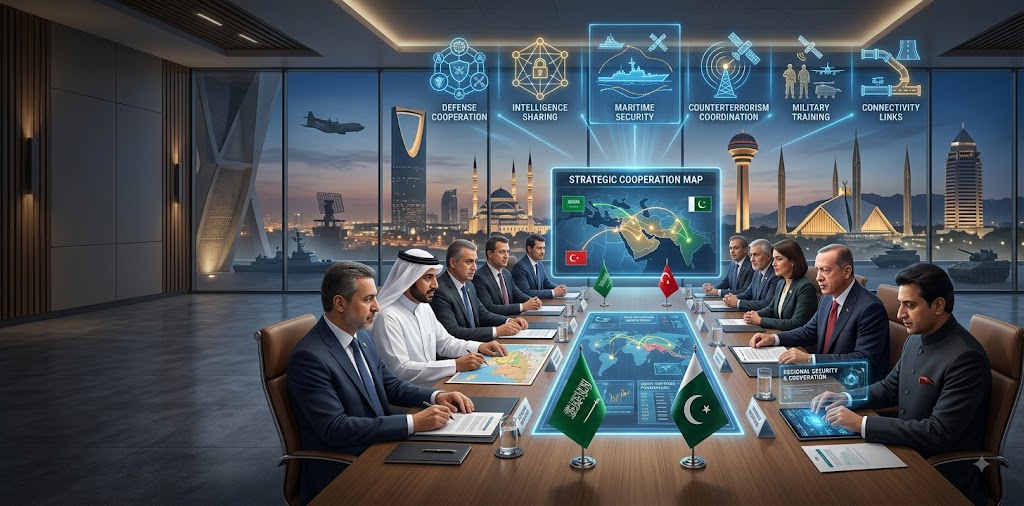
Strategic Cooperation between Saudi Arabia, Türkiye, and Pakistan reached a historic milestone on August 7, 2026, when the leaders of all three nations gathered in Mecca and signed the Mecca Joint Defence Agreement. The agreement stipulates that any armed attack against any one of the three states shall be regarded as an attack against them all, and provides for the enhancement of all aspects of defence cooperation among the three states. This NATO-style collective defense commitment unites three of the most militarily capable Muslim-majority nations in the world under a formal strategic framework at a moment when regional tensions, active conflicts, and questions about Western alliance reliability have never been more acute. Understanding what this agreement contains, why it happened now, and what it signals for regional security demands serious analysis
What the Mecca Joint Defence Agreement Contains and Why It Happened Now
The Mecca Joint Defence Agreement represents the formalization of Strategic Cooperation that has developed between these three nations over decades of bilateral engagement, now elevated to a binding trilateral security architecture.
The Agreement’s Core Commitment
The Mecca Joint Defence Agreement is a trilateral mutual defence pact signed on 7 August 2026 in Mecca by Saudi Arabia, Pakistan, and Turkey. The agreement builds on the September 2025 Pakistani-Saudi Strategic Mutual Defence Agreement to include Turkey.
The joint defence deal was guided by the longstanding historical ties among the three states, based on the enduring bonds of brotherhood and Islamic solidarity that unite them, and building upon their shared strategic interests and longstanding defence cooperation. The Strategic Cooperation framework covers joint military exercises, defense-industrial collaboration, technology transfer, and intelligence sharing. Each element addresses a specific gap in regional security capability that no single nation among the three could fill independently.
The three partners bring complementary strengths, including Turkey’s defence-industrial capabilities, Saudi financial muscle and influence, and Pakistan’s military experience and strategic deterrent. This complementarity makes the agreement more than a political statement. It creates a functional division of capabilities where each nation contributes assets the others need most.
The Regional Context That Made This Agreement Urgent
The agreement was signed against the backdrop of the 2026 Iran war that began in February 2026, as well as renewed fighting between Saudi Arabia and the internationally recognized Yemeni government against the Houthis militia in neighbouring Yemen.
Active regional conflict creates urgent demand for formalized Strategic Cooperation that informal relationships cannot reliably deliver at the speed and scale that warfare demands. Saudi Arabia needed documented commitments from capable military partners rather than goodwill understandings that political changes could dissolve.
During the 2026 Iran conflict, Pakistan reportedly deployed around 8,000 troops, a fighter-jet squadron, and an air-defense system to Saudi Arabia under its existing mutual defence agreement. That deployment demonstrated the practical value of the Saudi-Pakistan bilateral agreement signed in September 2025 and created momentum for expanding the Strategic Cooperation framework to include Türkiye’s substantial defense-industrial and military capabilities.
Building on a Bilateral Foundation
The Strategic Mutual Defence Agreement between Pakistan and Saudi Arabia was signed on 17 September 2025 at Al-Yamamah Palace in Riyadh by Crown Prince Mohammed bin Salman and Prime Minister Shehbaz Sharif. Under this agreement, both countries committed to treating any act of aggression against one as an act against both.
Turkey sought to join Saudi Arabia and Pakistan in this NATO-style military alliance, with talks on Turkey’s participation at an advanced stage. Ankara viewed the arrangement as a way to bolster security and deterrence amid questions over US reliability and President Donald Trump’s commitment to NATO, of which Turkey is a member.
Türkiye’s motivation to join the Strategic Cooperation framework reflects a broader recalibration of its security partnerships driven by uncertainty about Western alliance commitments. Expanding defense relationships with capable regional powers reduces dependence on any single alliance structure.
What the Mecca Agreement Means for Regional Security and Global Strategic Dynamics
The Strategic Cooperation formalized through the Mecca Joint Defence Agreement carries implications that extend far beyond the three signatory nations into every regional security calculation across the Middle East, South Asia, and beyond.
A New Security Architecture Takes Shape
The deal essentially puts three of the largest Muslim populations together on the roadmap for joint peace, to deter any act of aggression against them, to ensure they are in tune with each other when it comes to intelligence sharing, and to enhance cooperation in other areas including energy, defence expenditure, and manufacturing.
The Strategic Cooperation framework creates the region’s most capable trilateral defense alignment outside of existing formal alliances. Saudi Arabia contributes financial resources and strategic positioning at the center of Gulf security. Türkiye contributes a battle-tested military, advanced indigenous defense technology including drones and armored systems, and NATO interoperability. Pakistan contributes combat-experienced ground forces, air power, and nuclear deterrence capacity.
Together, these capabilities could create a substantially more capable Pakistani military ecosystem. The technology transfer dimension of the Strategic Cooperation agreement carries particular long-term significance. Pakistan gains access to Turkish defense technology and Saudi financial resources simultaneously, upgrading its military capability beyond what it could develop from domestic resources alone.
What This Agreement Does and Does Not Constitute
This is a framework for closer strategic, military, and defence-industrial coordination among three influential regional powers and not a mutual defence pact that can be compared to NATO.
Saudi Arabia has had a mutual defence agreement with Pakistan since September 2025 and with the six countries of the Gulf Cooperation Council since 2000. In practice, none of these has translated into the kind of response associated with NATO’s Article 5.
This honest assessment prevents overstatement of what the Mecca Agreement delivers immediately. The Strategic Cooperation framework creates legal architecture and political commitment. Converting that architecture into operational military integration requires years of joint exercises, shared doctrine development, and interoperability investment that the agreement initiates rather than completes.
Pakistan’s Strategic Position Strengthens
The agreement further embeds Pakistan in the emerging security architecture of the Middle East. It comes after Islamabad finalized a new mutual defence pact with Saudi Arabia, and at a moment when it is taking steps to deepen defence cooperation with other allies in the region, such as Egypt and Jordan. The agreement also brings Pakistan, with its Muslim-majority population and nuclear weapons capacities, more prestige and influence in the region.
Pakistan’s Strategic Cooperation with both Saudi Arabia and Türkiye creates economic benefits alongside security commitments. The Middle East is home to many of Pakistan’s top allies, a significant majority of its hydrocarbon imports, and several million Pakistani expatriates. Defense alignment with the region’s most capable powers protects all of these interests simultaneously.
India’s Reaction and Regional Balance Implications
India’s Ministry of External Affairs said it will study the implications of the strategic mutual defence pact between Saudi Arabia and Pakistan for India’s national security as well as for regional and global stability.
New Delhi watches the evolution of Strategic Cooperation between Pakistan and its Gulf and Turkish partners with genuine concern about the implications for the regional military balance. Pakistan gaining access to Turkish drone technology, Saudi funding, and formalized mutual defense commitments changes the security equation that India’s strategic planning must account for across every threat assessment dimension.
The Broader Signal to Global Powers
The Mecca Joint Defence Agreement sends a message that three major Muslim-majority nations choose to build their own Strategic Cooperation architecture rather than depending entirely on Western security guarantees or Chinese patronage. This independent positioning reflects confidence in their collective capacity and dissatisfaction with the reliability of existing external security relationships.
The agreement’s timing, signed during active regional conflict, demonstrates that Saudi Arabia, Türkiye, and Pakistan build Strategic Cooperation frameworks when they need them rather than during periods of relative calm when political will is easier to generate but operational urgency is lower.
Conclusion:
The Mecca Joint Defence Agreement represents one of the most significant developments in Muslim-majority nation Strategic Cooperation in modern history. Saudi Arabia’s financial and energy resources, Türkiye’s defense industry and military experience, and Pakistan’s combat capability and nuclear deterrent combine under a formal collective security framework that reshapes regional security architecture at a moment of maximum geopolitical pressure. The agreement’s long-term impact depends on whether the three nations invest in the joint exercises, interoperability development, and defense-industrial integration that convert political commitment into operational reality. The world watches a new security alignment take shape with consequences that no regional or global power can afford to ignore. For expert coverage of geopolitical developments, regional security analysis, and the strategic stories that shape international relations, visit DailyInfoRoom where serious global affairs find the clear and informed analysis they deserve.












