


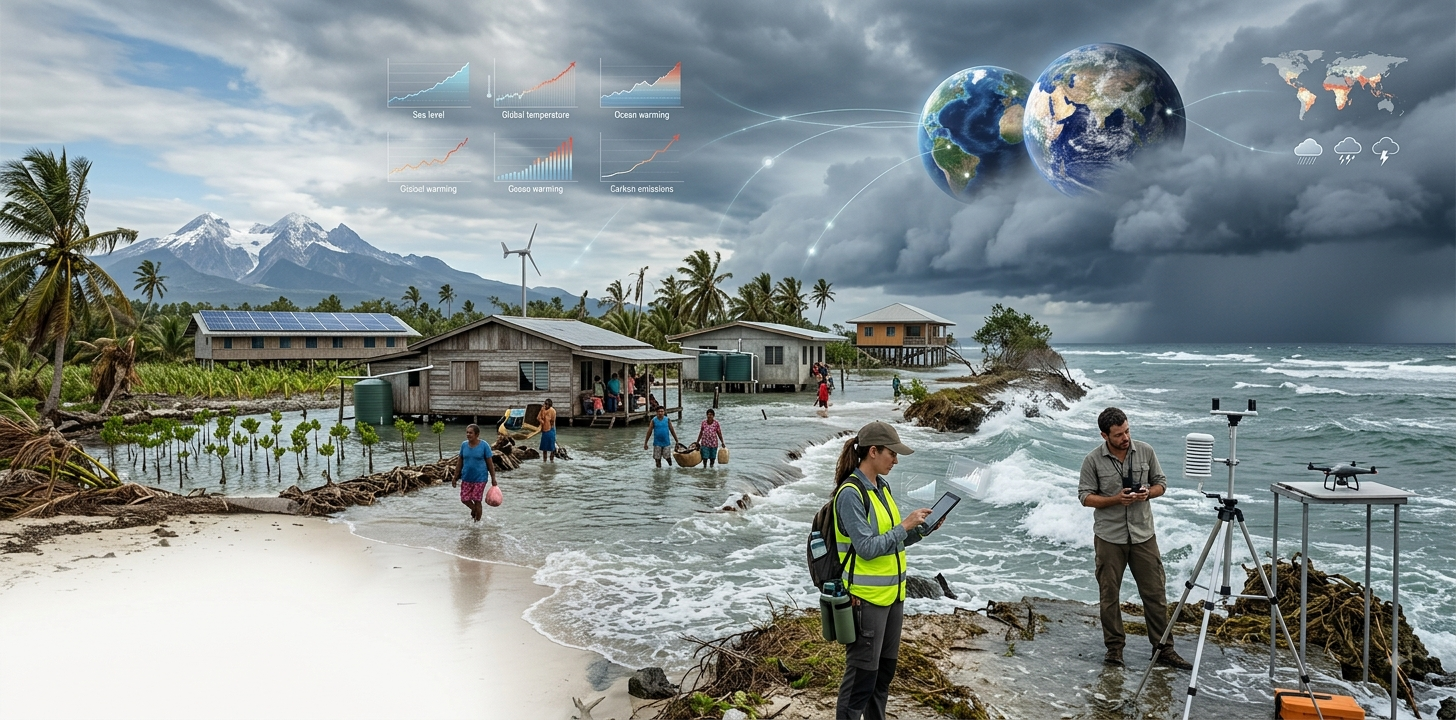
The First Country Impacted by Climate Change Tuvalu stands as the most powerful and heartbreaking symbol of what it means to be impacted by climate change at existential scale. This Pacific island nation, home to approximately 11,000 people spread across nine low-lying atolls and reef islands, faces a threat that no diplomatic negotiation, economic policy, or military force can address: the ocean is swallowing it whole. The island nation of Tuvalu is becoming the first country to be completely lost due to rising sea levels. What makes Tuvalu’s crisis a profound global injustice is not simply its scale but its cause. The people of Tuvalu produced virtually none of the greenhouse gas emissions responsible for the sea level rise destroying their homeland. They bear the full consequences of decisions made by industrialized nations on the other side of the world.
How Tuvalu Became the First Country Fully Impacted by Climate Change
Tuvalu’s vulnerability to climate change did not develop suddenly. The physical and environmental conditions that make this nation so acutely impacted by climate change have combined with accelerating global warming to create a crisis that scientists now treat as irreversible without dramatic global action.
The Geography That Creates Existential Vulnerability
Tuvalu is likely to be the first country in the world to become uninhabitable due to climate change. Scientists predict that 95% of the country will be underwater at high tide by the year 2100. The average elevation above sea level across Tuvalu’s islands measures just two meters, leaving no geographical buffer against the rising seas that global warming drives through thermal expansion and glacier melt.
A tiny low-lying archipelago nation in Oceania made up of three reef islands and six coral atolls, Tuvalu began attracting international attention as early as 1995, as rising Pacific Ocean levels, largely from global warming, began to threaten to submerge the nation, likely making its roughly 9,646 residents the world’s first climate refugees.
The Pacific Ocean surrounding Tuvalu does not simply rise uniformly. Regional ocean dynamics in the western Pacific amplify sea level rise beyond global averages, exposing Tuvalu’s atolls to flooding frequencies that compound the long-term submersion threat with immediate seasonal crises.
The Impacts Already Destroying Daily Life
Being impacted by climate change in Tuvalu means more than abstract future risk. The damage reshapes daily existence for every family on the islands right now.
The constant influx of saltwater is contaminating the country’s farmland and groundwater, leaving the island dependent on rainwater and vulnerable to droughts, water shortages, and disease outbreaks. Traditional food crops including taro and coconut require fresh groundwater that saltwater intrusion systematically destroys as sea levels push saline water further into the island’s interior.
Coastal erosion removes land permanently. Severe storm surges, intensified by warmer ocean temperatures, drive seawater across entire island sections rather than simply lapping at coastlines. Coral reef bleaching from warming waters destroys the natural barriers that historically absorbed wave energy before it reached inhabited areas.
Coral bleaching, extreme weather events, and sea level rise impact food security, affecting agriculture and aquaculture, leading to financial instability. An island economy built around fishing and subsistence agriculture cannot sustain itself when the ocean warms, the reefs die, the soil salts, and the freshwater disappears.
The Falepili Union: A Climate Migration Agreement
Tuvalu’s government recognized that being impacted by climate change would eventually require mass migration and negotiated the world’s first formal climate treaty addressing this reality.
Australia and Tuvalu signed the Falepili Union Treaty, which is an agreement that provides for a migration scheme that will allow 280 Tuvaluans per year to settle in Australia as permanent residents. This is the first climate visa of its kind.
In 2025, more than 90% of Tuvaluans applied for a visa scheme to obtain residency or citizenship in Australia. That application rate captures the lived reality of a population that loves its homeland but recognizes the ocean does not negotiate. In 2022, the Government of Tuvalu created the first digital nation in the metaverse to preserve its statehood and culture if its physical territory disappears.
The digital nation concept carries both practical and philosophical dimensions. Tuvalu’s government intends to maintain legal statehood, maritime rights, and cultural continuity even after physical land disappears beneath the ocean surface. International law currently provides no framework for a nation that exists without territory, making Tuvalu’s situation a challenge to the foundational assumptions of how the global legal order defines sovereignty.
Global Lessons From the Nation Most Impacted by Climate Change
Tuvalu’s crisis does not belong only to Tuvalu. Every government, every citizen, and every institution on earth carries responsibility for the conditions destroying this nation, and every country that ignores Tuvalu’s example increases its own future climate vulnerability.
The Inequality at the Heart of the Crisis
The ten most climate-vulnerable countries collectively contribute just 0.28% of global CO2 emissions while representing 5.16% of the world’s population. This stark inequality demonstrates that those least responsible for causing climate change are suffering its worst effects.
Tuvalu’s per capita carbon emissions approach zero. The industrialized nations whose economic activity drives the greenhouse gas concentrations responsible for sea level rise face none of the immediate existential consequences that Tuvalu absorbs entirely. This moral dimension demands acknowledgment before any honest conversation about climate justice can begin.
From 1995 to 2024, more than 832,000 lives were lost and direct economic losses of nearly USD 4.5 trillion were recorded, driven by more than 9,700 extreme weather events. These numbers represent the current cost of climate inaction distributed overwhelmingly across the nations least responsible for creating the crisis
Kiribati Faces the Same Fate
Tuvalu is the most prominent but not the only nation impacted by climate change at existential level. With an altitude of only three meters high, the water rises at a rate of 1.2 centimeters a year, four times faster than the global average, which makes Kiribati the most likely country to disappear due to rising sea levels in the forthcoming years.
Kiribati lost two islands, Abanuea and Tebua Tarawa, back in 1999. These were not uninhabited geological features. They were land formations with names, histories, and cultural significance to the Kiribati people that the ocean erased permanently before the global conversation about climate justice had fully begun.
The pattern of small island nations being impacted by climate change before wealthier nations face comparable threats reveals an uncomfortable truth about how the international community prioritizes response. Nations with small populations, limited economic power, and marginal geopolitical influence absorb the first and worst consequences while negotiations about emission reduction targets proceed over decades of insufficient progress.
What Adaptation Looks Like at the Limit
Developing countries often lack the infrastructure, early warning systems, and financial resources needed to prepare for and recover from climate disasters. Tuvalu demonstrates what happens when a nation reaches the absolute limit of adaptation capacity. Seawalls extend land life by years, not decades. Freshwater collection systems manage drought, but saltwater intrusion continues regardless. Coral restoration projects slow reef degradation, but warming ocean temperatures drive bleaching faster than restoration can compensate
Kiribati’s seawalls protect coastal communities as one layer of adaptation. Bangladesh, another nation severely impacted by climate change, has built 4,000 kilometers of embankments that reduce flood impacts by 30%. Malawi trains farmers in climate-smart agriculture. These adaptations matter and deserve support. They cannot substitute for the emissions reductions that prevent the underlying warming from reaching the levels that make adaptation mathematically impossible. The Finance Gap Leaves Vulnerable Nations Exposed
The $100 billion annual climate finance target was exceeded for the first time in 2022 with $115.9 billion provided. However, this amount remains insufficient as adaptation needs alone require $194 to $366 billion annually by 2030, and the total climate finance need is estimated at $2.4 trillion annually.
Nations most impacted by climate change cannot fund their own adaptation from domestic resources. They depend on climate finance commitments from wealthier nations that consistently fall short of what adaptation genuinely requires. The gap between what climate finance delivers and what vulnerable nations need represents a political failure with physical consequences measured in submerged land, contaminated water, and displaced populations.
Conclusion:
Tuvalu’s disappearance does not simply mark the loss of one small Pacific nation. It marks the first time in recorded history that climate change destroys an entire country, erasing a people, a culture, a language, and a civilization from the physical earth. The global lessons demand urgent action: emissions must fall faster, climate finance must reach the nations most impacted by climate change at the scale adaptation actually requires, and international law must evolve to protect the rights of peoples whose homelands the ocean claims. Every degree of warming prevented keeps the next Tuvalu above water. For more important coverage of climate change, environmental justice, global science, and the issues shaping humanity’s future, visit DailyInfoRoom where the stories that matter most find the readers ready to act on them.












