


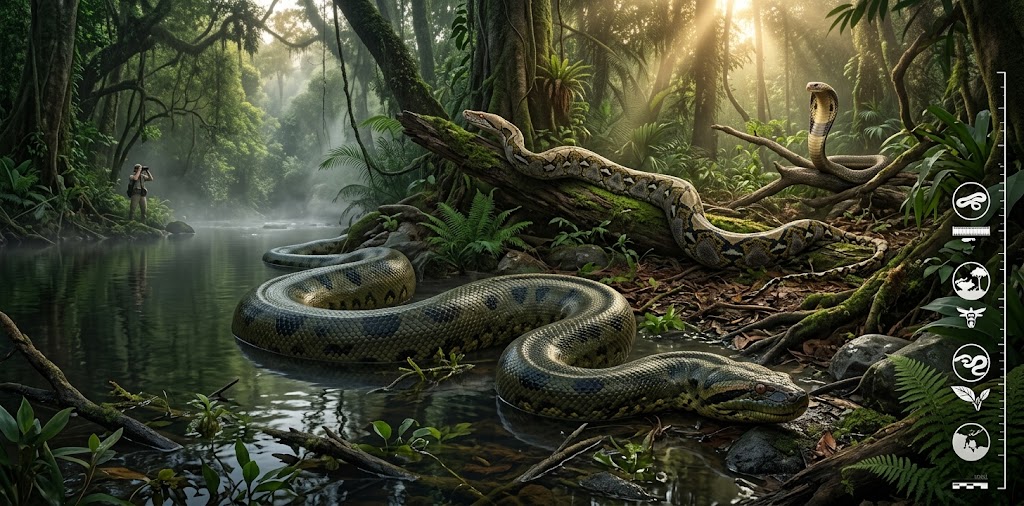
Slithering Giants occupy a unique place in the natural world where raw power, ancient biology, and extraordinary physical scale combine into creatures that have fascinated and terrified humans across every civilization in recorded history. Snakes represent one of nature’s most successful evolutionary experiments, having survived every mass extinction event that wiped out the dominant species of their respective eras. The largest among them achieve dimensions that challenge ordinary comprehension: lengths exceeding eight meters, weights surpassing 200 kilograms, and bite forces capable of subduing prey many times their own body mass. Slithering Giants do not simply impress through size alone. They demonstrate the full spectrum of predatory sophistication that 100 million years of uninterrupted evolutionary refinement produces in a limbless body plan.
Meet the Slithering Giants That Rule the Reptile World
Slithering Giants earn that title through measurable, documented physical attributes that place them in a category of biological achievement that no other group of reptiles approaches. Each of these species represents the pinnacle of scale evolution within its geographic range.
The Green Anaconda: Heaviest Snake on Earth
The green anaconda holds undisputed title as the heaviest snake species alive today. Female anacondas, significantly larger than males in this species, reach lengths between 5 and 8 meters and carry weights that regularly exceed 150 kilograms. The largest scientifically verified individuals approach 227 kilograms, giving them a body mass that surpasses every other snake species by a substantial margin.
Green anacondas inhabit the Amazon and Orinoco river basins across South America, spending most of their time partially submerged in slow-moving water where their enormous mass creates no mobility disadvantage. Water supports their weight while they move with surprising speed and silence toward prey that includes capybaras, caimans, deer, and large birds.
Slithering Giants like the green anaconda kill through constriction rather than venom. They wrap coils around prey and apply pressure that prevents the chest from expanding during inhalation. Prey dies from circulatory arrest as blood cannot flow from the heart under the pressure the constricting coils generate. The anaconda then swallows the prey whole, stretching its jaw ligaments and expandable esophagus to accommodate animals wider than its own resting head diameter.
The Reticulated Python: Longest Snake on Earth
The reticulated python surpasses every other snake species in maximum recorded length, making it the undisputed length champion among Slithering Giants worldwide. Reliable measurements confirm individuals reaching 6.5 meters regularly, with exceptional specimens approaching and occasionally exceeding 8 meters. The longest reticulated python ever reliably documented measured 7.67 meters and weighed 158 kilograms.
Reticulated pythons inhabit the rainforests, woodlands, and grasslands of Southeast Asia from Myanmar through Indonesia and into the Philippines. Their intricate geometric scale pattern in gold, black, and brown delivers camouflage that makes these enormous snakes almost invisible against forest floor leaf litter until they move.
These Slithering Giants demonstrate intelligence that herpetologists consider remarkable for reptiles. They learn the habits of prey species in their territory, ambushing at predictable water sources and game trails that target species use repeatedly. Reticulated pythons actively hunt rather than simply waiting for prey to approach, covering substantial distances while tracking scent trails with their chemoreceptive tongue.
The Burmese Python: The Invasive Titan
The Burmese python ranks among the most recognized Slithering Giants globally both for its impressive natural range in South and Southeast Asia and for its devastating impact as an invasive species in Florida’s Everglades ecosystem. Adult Burmese pythons in their native range regularly reach 5 meters, with females consistently growing larger than males as in all large python species.
In Florida, Burmese pythons grow larger than in their native range due to abundant food availability, warm climate, and the complete absence of natural predators. Researchers document Florida specimens regularly exceeding 5.5 meters and occasionally approaching 6 meters, with weights exceeding 90 kilograms in exceptional individuals.
The Everglades invasion demonstrates the ecological devastation that Slithering Giants cause when introduced outside their native range. Studies confirm mammal population declines exceeding 90% for multiple species including raccoons, opossums, bobcats, and rabbits across areas of high python density. The python population now numbers in the tens of thousands and actively resists every eradication effort that wildlife managers deploy against it.
The African Rock Python: The Continent’s Apex Constrictor
The African rock python commands respect across sub-Saharan Africa as the continent’s largest snake and one of the most aggressive large constrictor species among all Slithering Giants worldwide. Adults regularly reach 4.5 meters with exceptional specimens approaching 6 meters in the wild. Their muscular, heavy-bodied build gives them a weight-to-length ratio that makes them formidable opponents for any prey species in their range.
African rock pythons actively defend themselves when threatened rather than retreating as most large snake species prefer. They strike with significant force, bite with sharp curved teeth that create lacerating wounds, and constrict any attacker that holds contact long enough for the snake to wrap its coils. Documented prey includes warthogs, monitor lizards, large antelope species, and crocodiles in water environments where the python’s size advantage compensates for the crocodile’s defensive capabilities.
The Biology and Behavior That Make Slithering Giants the Ultimate Predators
Understanding why Slithering Giants achieve such extraordinary physical scale and predatory capability requires examining the biological systems that large constrictors developed through millions of years of evolutionary specialization for ambush predation on large prey.
Metabolism: The Engine Behind the Scale
Large constrictor snakes achieve their impressive size partly because their extraordinarily slow metabolic rate allows energy from each meal to contribute to growth rather than burning entirely as fuel for constant body heat maintenance. Slithering Giants maintain body temperature through behavioral thermoregulation, basking in sunlight to raise temperature and retreating to shade or water to cool, rather than generating internal heat metabolically as mammals do.
A large green anaconda or reticulated python can survive on as few as three to four large meals per year when food availability is limited. This metabolic efficiency means that calories do not maintain body temperature but instead build body mass, contributing directly to the extraordinary sizes that these species achieve over lifespans extending beyond 25 years in wild conditions.
Sensory Systems: Finding Prey in Total Darkness
Slithering Giants locate prey through sensory systems that operate independently of visible light, giving them effective hunting capability in complete darkness. Pit organs located in facial scales between the nostrils and eyes detect infrared radiation emitted as body heat from warm-blooded prey. These thermoreceptive pits create a thermal image of the environment that allows pythons and anacondas to detect, track, and strike warm-blooded prey with precision in zero-visibility conditions.
The forked tongue collects chemical particles from the air and transfers them to the Jacobson’s organ in the roof of the mouth, which processes scent information with sensitivity that allows tracking of prey across significant distances through vegetation. Combined with pressure-sensitive scales that detect ground vibrations from approaching prey, these sensory systems give Slithering Giants predatory awareness that compensates completely for their inability to pursue prey over distance.
Reproduction: The Next Generation of Giants
Large constrictor species invest heavily in reproduction in ways that reflect their evolutionary priority of maximizing offspring survival rather than maximizing offspring number. Reticulated pythons and African rock pythons lay clutches of eggs ranging from 20 to 100 eggs, coiling around the clutch throughout the incubation period and generating heat through muscular contractions that raise clutch temperature several degrees above ambient air temperature.
Female Slithering Giants sacrifice significant body mass during egg incubation by refusing to feed while protecting the clutch. The energy expenditure of incubation behavior combined with months of fasting reduces the female’s body condition significantly after successful hatching. Hatchling large constrictors emerge fully capable of independent hunting, typically measuring 60 to 90 centimeters at hatching in the largest species and growing rapidly when prey is abundant in their first years of life.
Conservation Status and Human Threats
Several species among the world’s Slithering Giants face significant population pressure from human activities including habitat destruction, hunting for skin and meat, and collection for the international pet trade. Reticulated pythons face intensive hunting pressure across their Southeast Asian range, with millions of individuals harvested annually for fashion industry leather products. Burmese python populations in their native range have declined significantly due to agricultural conversion of wetland and forest habitat.
International trade regulations under CITES provide some protection for the largest constrictor species, restricting commercial harvest in signatory nations. Effective enforcement remains inconsistent across the ranges of most large constrictor species, however, allowing harvest pressure to continue affecting wild populations in ways that population surveys document without adequate regulatory response.
Conclusion:
Slithering Giants represent the most extraordinary achievement in snake evolution across 100 million years of uninterrupted biological development on every habitable continent. The green anaconda’s crushing weight, the reticulated python’s astonishing length, the Burmese python’s invasive success, and the African rock python’s aggressive power each demonstrate what evolution produces when a limbless body plan optimizes for large prey capture across diverse habitat types. These species deserve both respect and serious conservation attention because their ecological roles as apex predators regulate prey populations and maintain the ecosystem balances that entire food webs depend on. Slithering Giants remind every observer that nature’s engineering never stops producing solutions that human design cannot match. For more captivating wildlife content, natural history exploration, science stories, and topics that expand your understanding of the living world, visit DailyInfoRoom where curiosity finds the knowledge it deserves every single day.












