


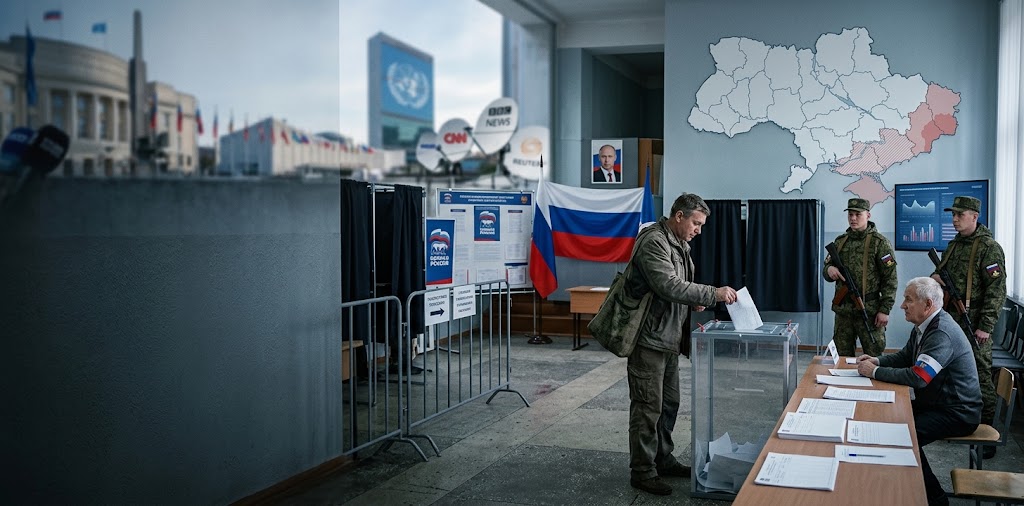
Russia’s 2026 parliamentary election has drawn international attention because authorities held voting in Russian-occupied parts of Ukraine while President Vladimir Putin’s United Russia party strengthened its position in the State Duma. United Russia won 355 of 450 parliamentary seats, according to Russia’s Central Election Commission figures reported by Reuters. The result gave the party a constitutional majority.
The voting created a major dispute over legitimacy. Ukraine, the OSCE and several governments rejected Russia’s organization of elections in occupied Ukrainian territory. They argue that Russia cannot use elections to change the internationally recognized status of Ukrainian territory.
United Russia Expands Its Control Over Parliament
The 2026 Russian parliamentary election gave United Russia a larger share of seats than it held after the previous national vote. Reuters reported that the party received 57.83 percent of the vote and secured 355 seats in the 450 member State Duma. The result allows the party to pass legislation and constitutional amendments without relying on other parliamentary groups.
The political environment surrounding the election remained tightly controlled. The Associated Press reported that Russia’s only registered anti war party, Yabloko, did not appear on the national ballot after authorities excluded it from the election process. Several anti war figures faced imprisonment, exile or other restrictions.
These conditions shaped the political competition before voters cast their ballots. The Kremlin presented the election as a demonstration of national unity during the war with Ukraine. Critics and opposition activists challenged the fairness of the process and alleged widespread restrictions and electoral violations. Reuters reported that Russian officials described the vote as clean while opposition activists disputed that assessment.
The election also included voting in territories that Russia claims to have annexed from Ukraine. Russian authorities treated those areas as part of the electoral system. Ukraine and international organizations rejected that position.
The OSCE Parliamentary Assembly and its election monitoring institutions said Russia’s decision to organize voting in temporarily occupied Ukrainian territories violated international law and Ukraine’s territorial integrity. The organization stated that results from such elections have no validity under international law.
Why the Ukraine Election Dispute Matters
The phrase Ukraine Election can create confusion because Ukraine did not hold a national election that produced the reported United Russia result. The disputed voting concerns Russia’s parliamentary election and Russia’s decision to include occupied Ukrainian territories within that electoral process.
Russia has held similar votes in Crimea and other occupied Ukrainian regions. Governments including Australia, Canada, New Zealand, Norway and the United Kingdom condemned the 2026 voting in those territories. Their joint statement said Russia’s actions violate Ukrainian sovereignty and the UN Charter.
The dispute extends beyond the ballot itself. The OSCE reported evidence that Russian authorities have sought to integrate occupied areas into Russia through administration, citizenship requirements, education policies and other measures. Its reporting documented accounts of pressure on residents to obtain Russian citizenship and comply with Russian systems.
The United Nations has continued to reaffirm Ukraine’s territorial integrity within its internationally recognized borders. UN reporting on the occupied territories has documented continuing human rights concerns affecting residents under Russian occupation.
Russia presents the elections differently. Moscow treats the occupied territories as Russian regions and conducts voting there under Russian law. Ukrainian authorities reject that legal position and describe the elections as illegitimate.
The controversy has a direct connection to the broader war. Elections normally depend on voters receiving political information freely, choosing among competing candidates and participating without intimidation. Conditions in occupied territories create serious questions about whether residents can exercise those rights freely.
The UK government and its international partners have cited coercion and repression in occupied Ukrainian territories. Their September 2026 statement linked the elections with broader Russian efforts to impose Russian administration, law, education, media and citizenship systems on residents.
The situation means readers should distinguish between Russia’s parliamentary election and a Ukrainian national election. The reported victory belongs to Putin’s United Russia party in Russia’s State Duma vote. The controversy involving Ukraine centers on Russia holding that vote in territories that remain internationally recognized as Ukrainian.
Conclusion: What the Election Result Means for the Ukraine Dispute
The 2026 Russian parliamentary election strengthened United Russia’s control of the State Duma and gave Putin’s political system a larger parliamentary majority. The vote in occupied Ukrainian territories created a separate international dispute over sovereignty, electoral legitimacy and international law. Ukraine, the OSCE and several governments reject Russia’s authority to conduct elections in those areas.
The Ukraine Election issue therefore connects directly with the wider conflict and competing claims over occupied territory. Understanding the difference between Russia’s parliamentary vote and Ukraine’s own electoral process helps readers follow the political developments accurately. Follow DailyInfoRoom for more informative coverage of world affairs, politics, technology and global news.












