


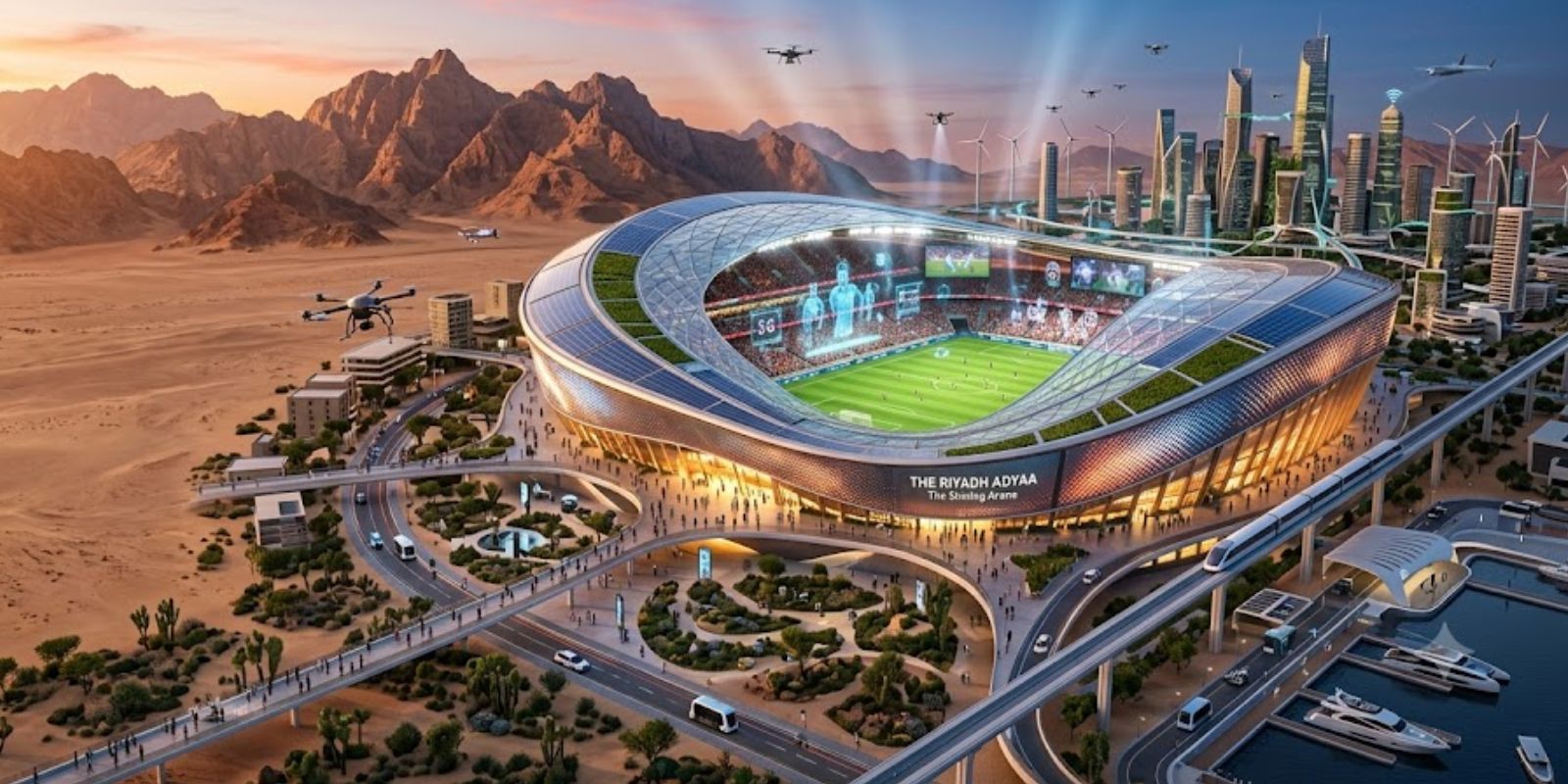
NEOM Stadium stands as the most extraordinary football venue ever planned in the history of the sport. Sitting 350 meters above the ground and integrated directly into the roof structure of The Line, Saudi Arabia’s futuristic linear city, this venue redefines what a football stadium can be. The 46,010-capacity NEOM Stadium will host matches at the 2034 FIFA World Cup, with construction set to begin in 2027 and completion targeted for 2032. No stadium in the world combines altitude, renewable energy, smart city integration, and architectural ambition at this scale. Understanding what NEOM Stadium represents, how it works, and what it signals for the future of football infrastructure gives a clear picture of how dramatically the sport’s relationship with technology has evolved.
What Makes NEOM Stadium the Most Unique Football Venue Ever Built
NEOM Stadium breaks every conventional rule about where and how football stadiums get built. The stadium sits more than 350 meters above ground level, with its roof extending as part of the city’s skyline, offering an unprecedented football match experience and embodying one of the world’s most prominent landmarks. No other sports venue in history has attempted anything close to this concept.
Integration Into The Line
NEOM Stadium sits within The Line, the linear city project under development within the NEOM megaproject. The stadium plans to be powered largely by renewable energy from solar and wind sources and will serve as a landmark within the city’s architecture.
The Line itself stretches across the Saudi Arabian landscape as a continuous vertical urban structure. NEOM Stadium will run entirely on renewable energy from wind and solar sources. Transportation systems within the district will be entirely electric, with a five-minute walkability model promoting travel on foot.
Every design decision prioritizes sustainability and smart urban integration over conventional stadium thinking. This venue does not exist beside a city. It exists as part of one.
Capacity and World Cup Role
NEOM Stadium carries a proposed capacity of 46,010 people and will host fixtures in the group stage, round of 32, round of 16, and quarter-finals of the 2034 FIFA World Cup.
The NEOM Stadium’s capacity of 46,010 exceeds the minimum requirement of 40,000 seats for a quarter-final venue, positioning it as one of the tournament’s key knockout-stage locations.
Hosting quarter-final matches at a venue sitting 350 meters above ground level creates a setting for high-stakes football that the sport has never experienced before. Players competing at NEOM Stadium will perform in conditions unlike anything previous generations of footballers encountered.
Construction Partnership and Engineering Challenge
The 46,000-capacity NEOM Stadium will be designed and constructed in partnership with NEOM, the Saudi Ministry of Sport, and the Public Investment Fund, with work set to begin in 2027 and conclude in 2032, two years before the World Cup begins.
Building a stadium at 350 meters above ground inside a linear vertical city structure presents engineering challenges that no construction team has previously tackled. Load-bearing requirements, wind resistance at altitude, crowd management for 46,000 spectators accessing a structure at extreme height, and integration with The Line’s internal transportation systems all demand solutions that push engineering knowledge to its current limits.
Program-wise, NEOM Stadium will serve as home to a men’s and women’s professional football club and a base for the club, fans, community activities, and major events beyond the 2034 World Cup.
The venue carries a permanent legacy purpose that extends well beyond tournament football. Saudi Arabia builds NEOM Stadium as a long-term community asset, not simply a World Cup showcase.
NEOM Stadium and the Future of Smart Stadium Design Worldwide
NEOM Stadium does not just represent ambition within Saudi Arabia’s 2034 World Cup plans. It signals a broader shift in how football venues will integrate technology, sustainability, and urban planning in the decades ahead.
Renewable Energy as a Stadium Standard
NEOM Stadium will run entirely on renewable energy from wind and solar sources. This commitment places the venue at the forefront of a movement already gaining momentum across global football infrastructure. Traditional stadiums consume enormous amounts of energy for lighting, climate control, media operations, and fan facilities. A venue that generates all required power from renewable sources on-site sets a benchmark that future stadium developers across every continent will reference.
The combination of wind energy at altitude and solar generation creates a dual-source renewable model that suits The Line’s geographic location and structural configuration. Future stadium projects in sun-rich and wind-exposed locations will study NEOM Stadium’s energy architecture as a template for reducing operational carbon footprints without sacrificing the event experience fans expect.
Smart City Integration as the New Stadium Model
NEOM Stadium breaks the traditional model of a stadium as an isolated venue surrounded by parking lots and access roads. The structure integrates directly into an urban district designed around five-minute walkability and all-electric transportation.
This integration approach represents where forward-thinking stadium development moves globally. Cities from London to Tokyo to Los Angeles increasingly plan sports venues as components of urban districts rather than standalone destinations. NEOM Stadium takes that philosophy further than any project has attempted, embedding a 46,000-seat football venue into a continuous city structure with shared infrastructure, shared public space, and shared community purpose.
Technology and the Fan Experience
NEOM Stadium plans to incorporate cutting-edge technology at the heart of Saudi Arabia’s Vision 2030 initiative. Smart stadium technology already transforms fan experiences at major venues worldwide through real-time data, cashless transactions, augmented reality overlays, personalized navigation, and biometric access systems.
NEOM Stadium’s position within The Line’s technological ecosystem creates opportunities for fan experience innovation that conventional venues cannot replicate. Visitors to the stadium move through a smart city environment before they reach the pitch, with integrated services, real-time information, and seamless connectivity accompanying them from their accommodation to their seat.
Saudi Arabia’s 2034 Vision Beyond the Tournament
Saudi Arabia’s 2034 World Cup preparations form a major milestone in the nation’s long-term Vision 2030 strategy. The tournament will be held across five key cities: Riyadh, Jeddah, Al Khobar, Abha, and NEOM, each featuring world-class stadiums built or upgraded to meet FIFA’s standards.
Eleven entirely new stadiums are under development, with four existing venues undergoing redevelopment. NEOM Stadium sits at the apex of this program as the most visually striking and technologically ambitious venue in the entire 2034 infrastructure plan.
Saudi Arabia uses the 2034 World Cup as an accelerator for long-term development goals that extend decades beyond the tournament itself. NEOM Stadium anchors the NEOM city project with a globally recognized sports venue that attracts international attention, investment, and tourism to a city that will still be growing and developing well into the second half of this century.
What NEOM Stadium Means for Global Football Infrastructure
Every major international tournament pushes host nations to build or upgrade venues that set new standards for subsequent generations of stadium development. Qatar 2022 demonstrated what climate-controlled environments and compact tournament geography could achieve. Saudi Arabia 2034 plans to demonstrate what happens when a football stadium becomes part of a city’s fundamental structure rather than an addition to it.
NEOM Stadium will generate debate, scrutiny, and admiration in equal measure from architects, engineers, urban planners, and football administrators worldwide. The questions it raises about altitude, access, sustainability, and smart city integration will shape stadium development conversations for years after the 2034 tournament concludes.
Conclusion:
NEOM Stadium represents football’s most dramatic leap into the future yet attempted. A 46,000-seat venue sitting 350 meters above the ground, powered entirely by renewable energy, integrated into a smart city structure, and hosting World Cup quarter-finals in 2034 pushes the boundaries of what sport and architecture can achieve together. Saudi Arabia builds this venue as a statement about where football infrastructure heads next and where Vision 2030 ambitions take the nation over the coming decades. The world will watch NEOM Stadium’s construction with a mixture of fascination and genuine curiosity about what it delivers. For in-depth coverage of football infrastructure, stadium design, World Cup developments, and global sports stories worth following, visit DailyInfoRoom where the future of sport gets the coverage it deserves.












