

Elon Musk’s Starlink transformed modern warfare in ways that military strategists, defense analysts, and geopolitical observers had never fully anticipated before Russia’s full-scale invasion of Ukraine began in February 2022. Within days of the invasion, Russian forces destroyed critical Ukrainian telecommunications infrastructure, cutting off conventional internet connectivity across large swaths of the country and leaving military units, emergency services, and civilian populations without reliable communication. SpaceX activated Elon Musk’s Starlink terminals across Ukraine rapidly, restoring connectivity that Ukrainian forces used to coordinate defense operations, share real-time battlefield intelligence, and maintain the command communications that modern military operations depend on completely. What followed reshaped every serious conversation about the role of commercial space technology in 21st-century conflict.
How Elon Musk’s Starlink Became Ukraine’s Most Critical Communication Infrastructure
Elon Musk’s Starlink delivered capabilities to Ukrainian forces that no other technology available at the time could replicate at the scale, speed, and reliability that active warfare demanded across a conflict zone stretching thousands of kilometers.
Immediate Deployment at Scale
SpaceX shipped thousands of Starlink terminals to Ukraine within weeks of the invasion beginning. Governments including the United States, United Kingdom, and Poland funded terminal acquisitions and shipping logistics that placed Elon Musk’s Starlink hardware in the hands of Ukrainian military units, territorial defense forces, hospitals, government agencies, and civilian communities that Russian strikes had cut off from conventional internet infrastructure.
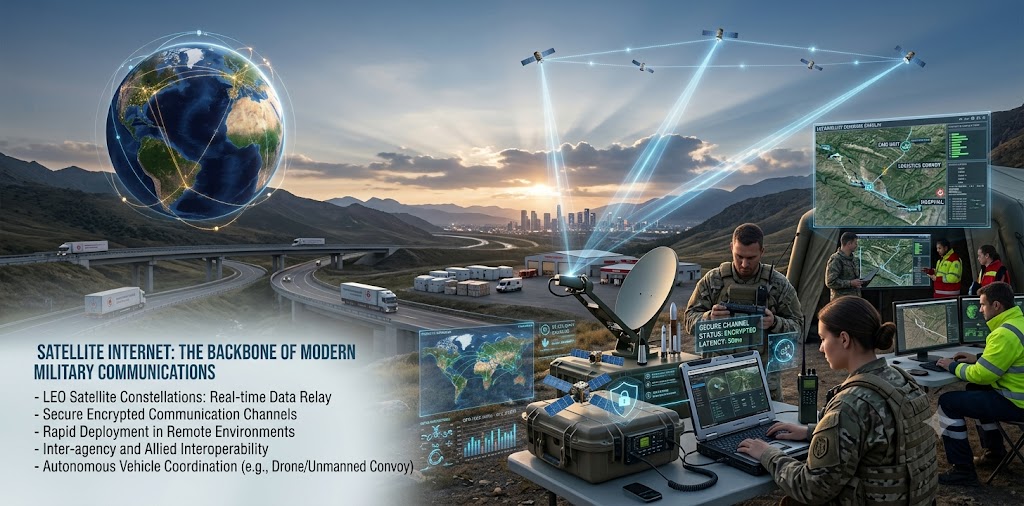
By mid-2022, Ukrainian forces operated tens of thousands of active Starlink terminals across the conflict zone. No other satellite internet provider offered comparable coverage, latency performance, terminal portability, or activation speed. Elon Musk’s Starlink operates through a low Earth orbit constellation sitting approximately 550 kilometers above the surface, delivering latency figures of 20 to 40 milliseconds that support real-time video communication, drone control, and data-intensive applications that higher-altitude geostationary satellites cannot serve adequately for military operational purposes.
Drone Warfare Revolution
Ukrainian forces integrated Elon Musk’s Starlink connectivity directly into their drone warfare operations, creating battlefield capabilities that proved decisive in multiple engagements. Commercial drones modified for military use require reliable low-latency data connections to transmit live video feeds, receive operator commands, and coordinate in swarm formations that multiply their individual effectiveness.
Ukrainian operators connected drone control stations to Elon Musk’s Starlink terminals and flew precision strike missions against Russian armor, artillery positions, supply convoys, and command posts with an operational tempo that Russian forces struggled to anticipate and counter effectively. The ability to operate drones reliably across contested territory without depending on fixed ground-based communication infrastructure gave Ukrainian units tactical flexibility that Starlink connectivity enabled directly.
Command and Control Restoration
Russian military doctrine targeted Ukrainian command and control infrastructure in the opening hours of the invasion specifically to degrade Ukraine’s ability to coordinate a coherent defense. Destroying telecommunications nodes, fiber optic networks, and military communication systems represented a deliberate strategy to fragment Ukrainian resistance before it could organize effectively.
Elon Musk’s Starlink defeated this strategy by providing a communication layer that Russian strikes could not systematically disable. Individual terminals are small, portable, and easily relocated. Ukrainian commanders moved terminals with their units, maintaining connectivity regardless of physical location. Brigade-level communications, artillery coordination, intelligence sharing between units, and direct contact with senior military leadership all flowed through Elon Musk’s Starlink connections that Russian electronic warfare and physical strikes struggled to suppress reliably.
The Complications, Controversies, and Future of Elon Musk’s Starlink in Warfare
Elon Musk’s Starlink in Ukraine generates questions and controversies alongside its documented military contributions that defense analysts, policymakers, and ethicists actively debate as the technology’s role in modern conflict becomes permanently established.
The Crimea Bridge Episode and Service Restrictions
The most significant controversy surrounding Elon Musk’s Starlink involvement in Ukraine emerged in September 2022 when Walter Isaacson’s biography of Elon Musk revealed that Musk had personally intervened to disable Starlink connectivity in Crimean waters at a critical moment. Ukrainian forces reportedly planned a drone submarine attack on the Russian Black Sea Fleet anchored near Sevastopol. Starlink connectivity dropped in that area, the drones lost their guidance connections, and the attack failed to execute.
Musk justified the decision by stating he feared enabling an attack of that nature could trigger a nuclear escalation response from Russia. Ukrainian officials expressed anger that a private commercial operator made a unilateral decision to restrict a military capability at a moment of operational significance without Ukrainian authorization. The episode crystallized a fundamental tension within the Elon Musk’s Starlink military relationship: a private company controlled by one individual making operational decisions that affect sovereign military operations represents a governance model that no established military doctrine had ever anticipated or prepared for adequately.
Electronic Warfare Countermeasures and Adaptation
Russian forces developed electronic warfare capabilities targeting Elon Musk’s Starlink terminals throughout the conflict as the system’s military importance became undeniable. Signal jamming, direction-finding equipment to locate active terminals, and drone strikes targeting terminal locations all represented Russian countermeasure investments in response to Starlink’s operational impact.
SpaceX responded through software updates that improved jamming resistance, modified transmission protocols, and enhanced the terminals’ ability to maintain connectivity under electronic warfare conditions. This dynamic created a technology competition between SpaceX engineering teams and Russian electronic warfare specialists that played out in real time across an active battlefield, a precedent that future conflicts will almost certainly replicate.
Ukrainian forces adapted terminal deployment practices to reduce vulnerability, moving terminals frequently, limiting transmission periods, and dispersing terminal locations to prevent individual strike missions from eliminating significant connectivity capacity. Elon Musk’s Starlink proved resilient not just through technical robustness but through the operational adaptability of the users who depended on it under genuine combat conditions.
The Dependency Problem for Military Strategy
Defense analysts studying Elon Musk’s Starlink in Ukraine identify a strategic dependency concern that military establishments worldwide now incorporate into planning discussions. Ukraine’s military operations developed significant dependence on a commercial satellite network controlled by a private American citizen operating outside any formal military alliance structure or binding contractual obligation.
SpaceX and the US government eventually formalized some aspects of the Starlink relationship with Ukraine through official contracts and government funding arrangements, but the fundamental governance gap remained. Military planners considering Elon Musk’s Starlink integration into their own force structures now grapple with questions about service continuity guarantees, operational security, data handling practices, and the circumstances under which a private operator might restrict or modify service based on individual judgment about geopolitical risk.
NATO allies began accelerating investment in sovereign military satellite communication capabilities after observing Ukraine’s experience, recognizing that dependence on commercial providers however capable creates strategic vulnerabilities that dedicated military systems avoid.
Starlink’s Role in Future Warfare
Elon Musk’s Starlink in Ukraine established satellite internet connectivity as a fundamental military infrastructure requirement that future conflicts will treat as essential as ammunition, fuel, and manpower. Every military force observing the Ukraine conflict closely now evaluates low Earth orbit satellite communication integration into their operational doctrine, training programs, and equipment procurement plans.
The commercial space industry took direct lessons from Starlink’s performance in Ukraine as well. Competing satellite internet providers including Amazon’s Project Kuiper and European programs accelerated development timelines after observing the military demand signal that Ukraine demonstrated so clearly. Defense contractors began incorporating Starlink terminal integration into vehicle designs, drone systems, and portable command post configurations that assume persistent satellite connectivity as a baseline operational condition.
Future warfare will feature satellite internet connectivity as ubiquitous as radio communication became in the 20th century. Elon Musk’s Starlink in Ukraine provided the real-world proof of concept that moved this capability from theoretical military planning discussions to documented operational reality in the most consequential way possible.
Conclusion:
Elon Musk’s Starlink in Ukraine demonstrated that commercial satellite technology now sits at the center of modern warfare in ways that reshape military strategy, alliance relationships, and the role of private technology companies in national security decisions. Ukraine’s forces used Starlink connectivity to coordinate defense, revolutionize drone warfare, maintain command structures under sustained attack, and resist a conventional military invasion by a major power in ways that previous generations of defense analysts would have considered impossible without comparable military hardware advantages. The questions the technology raises about private control of critical military infrastructure demand serious answers that governments worldwide now actively pursue. For in-depth analysis of military technology, geopolitical developments, global security, and the emerging intersection of commerce and conflict, visit DailyInfoRoom where the stories that shape the world find the readers ready to engage with them.