


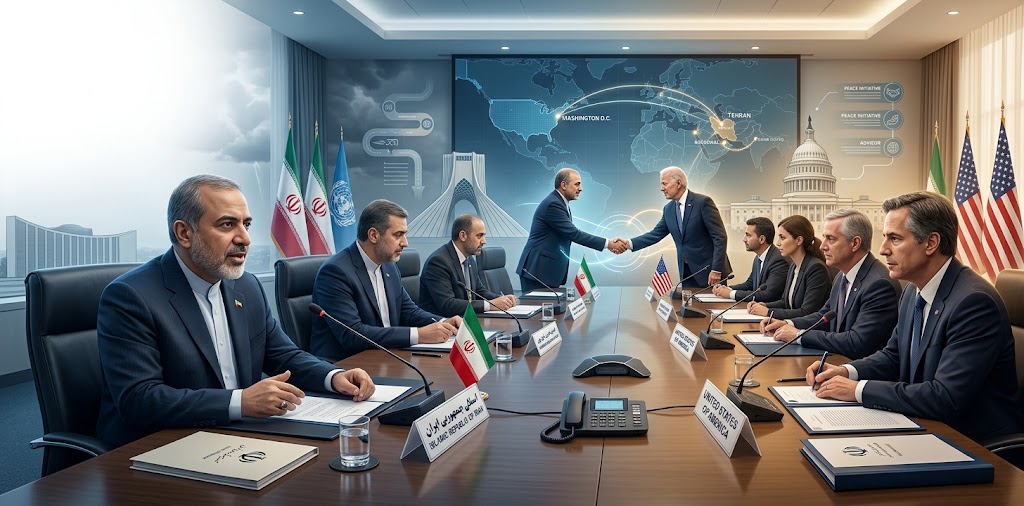
Iran President Defends Deal with the United States on August 23, 2026, in a speech that carries enormous significance for the Middle East, global energy markets, and the fragile diplomatic architecture attempting to end a conflict that has already reshaped the region. Iranian President Masoud Pezeshkian defended a recent memorandum of understanding as the best way for the country to move beyond what he described as a situation of “neither war nor peace.” Pezeshkian said members of Iran’s Supreme National Security Council believed the memorandum represented the best possible agreement based on what he described as dignity, wisdom, and the national interest. His public defense of the deal comes at a moment when domestic opposition, new sanctions threats, and stalled negotiations make every diplomatic statement consequential and potentially decisive.
What the Deal Contains and Why Iran’s President Defends It So Forcefully
Iran President Defends Deal not simply as a political calculation but as a genuine conviction that the memorandum of understanding represents the most viable pathway out of an economically devastating and militarily draining conflict.
The Memorandum of Understanding and Its Core Terms
The deal known as the Memorandum of Understanding that US President Donald Trump signed in June set an ambitious 60-day deadline for ending the war with Iran and reaching an accord on its nuclear program. That period ended last week, but the two sides remain far apart, with no signs of compromise on the crucial issue of reopening the Strait of Hormuz, vital to global shipping.
The Strait of Hormuz closure sits at the center of the diplomatic stalemate that makes it particularly significant when Iran President Defends Deal against critics who argue Tehran has conceded too much without receiving sufficient guarantees. Approximately 20% of the world’s oil supply passes through the Strait daily, meaning its continued closure creates economic pressure on both Iran’s trading partners and the global energy markets that every major economy depends on for industrial and consumer fuel supply.
Pezeshkian said there is not a single provision in this agreement that amounts to capitulation. “The supreme leader sets the policies, and we will follow that path.” That statement addresses the hardliner criticism that any agreement with Washington represents submission to American pressure rather than a negotiated outcome serving Iranian national interests.
The Economic Dimension Driving the Defense
Iran President Defends Deal with explicit acknowledgment of the economic suffering that the conflict’s continuation imposes on ordinary Iranian citizens whose daily lives, purchasing power, and economic prospects deteriorate with every week that the war continues without resolution.
Pezeshkian linked the agreement to Iran’s economic wellbeing in a direct and politically significant way. Iranian citizens experience the consequences of international isolation, sanctions-driven inflation, energy sector disruption, and currency depreciation that prolonged conflict and maximum economic pressure campaigns produce at a scale that no government can indefinitely sustain without addressing the underlying political resolution that removes the sanctions rationale.
Treasury Secretary Scott Bessent on Monday is expected to announce new economic measures against Iran after the US vowed to impose an unprecedented level of economic warfare and isolation. The threat of additional sanctions creates urgency in Iran President Defends Deal arguments by demonstrating concretely what continued conflict costs compared to the diplomatic pathway that the memorandum represents
Pakistan as Mediator and the Diplomatic Architecture
Pakistan’s army chief planned to travel to Tehran on Monday, Iranian media reported, as mediators try to revive talks. Pakistan’s active mediation role reflects the diplomatic architecture that regional powers construct when direct negotiation between adversaries lacks the trust and channel reliability that effective diplomacy requires. Pakistan maintains relationships with both Iran and the United States that position it as a credible intermediary whose presence in Tehran signals continuing momentum toward the negotiated resolution that Iran President Defends Deal as achieving
The Internal Opposition and External Pressures Testing Iran’s Presidential Resolve
Iran President Defends Deal against simultaneous pressure from hardline domestic factions who reject any compromise with Washington and external actors whose actions threaten the fragile diplomatic progress that the memorandum represents.
The Security Council Divide Within Iran’s Government
The new head of the Islamic Republic’s top security body took a more defiant stance than Pezeshkian, warning of retaliation if neighbors support US threats to further sanction Tehran. This public contradiction between the president and the security council head reveals the genuine internal division within Iran’s government about the memorandum’s wisdom and the appropriate response to continued American pressure.
Iran President Defends Deal in a political environment where revolutionary guard commanders, hardline clerical figures, and security establishment voices consistently argue that diplomatic accommodation with the United States rewards aggression and weakens Iran’s deterrence posture for future confrontations. Managing this internal opposition while pursuing the diplomatic pathway that the memorandum represents requires political skill and supreme leader backing that Pezeshkian explicitly acknowledged by stating that he follows the supreme leader’s policies.
The supreme leader’s position carries ultimate authority in Iran’s political system, making Pezeshkian’s repeated references to following Khamenei’s guidance both constitutionally accurate and politically essential for the credibility that Iran President Defends Deal requires domestically. An Iranian president arguing for a deal that the supreme leader opposes would have zero diplomatic leverage and zero domestic political survival. His public confidence signals supreme leader alignment that gives the presidential defense genuine weight.
The Nuclear Program Question at the Deal’s Center
Iran’s nuclear program represents the most consequential and technically complex dimension of the negotiations that the memorandum of understanding initiated. The United States and its allies demand verifiable restrictions on uranium enrichment levels, centrifuge numbers, and monitoring access that Iran historically frames as infringements on national sovereignty and peaceful nuclear rights.
Iran President Defends Deal in the context of a nuclear program that the Iranian government consistently describes as civilian in purpose and legally protected under the Nuclear Non-Proliferation Treaty frameworks that Iran participates in. The diplomatic challenge involves finding formulations that address Western verification concerns without requiring Iran to formally abandon the nuclear rights framework that Iranian governments across ideological lines treat as a non-negotiable legal position.
The Strait of Hormuz as the Breaking Point
The Strait of Hormuz closure remains the most concrete and immediately consequential element of the dispute that the memorandum must resolve for any broader peace agreement to materialize. The Strait of Hormuz has remained largely closed since the start of the Middle East war in late February, and the US President signaled on August 9 that he was prepared to let economic pressure mount against Iran, apparently backing away from more military strikes after Tehran issued a list of conditions for reopening the waterway.
Iran’s conditions for reopening the Strait give Tehran its strongest remaining diplomatic leverage because the closure imposes severe economic costs on oil-importing nations, creates inflationary pressure across global supply chains, and forces every government with energy import dependence to advocate for a resolution that reopens the waterway. Iran President Defends Deal partly on the basis that the memorandum provides a framework for resolving the Strait question without Iran appearing to capitulate to military or economic pressure, which would undermine the deterrence credibility that Iranian military doctrine depends on for future security calculations.
What Success Would Mean for the Region
A successful conclusion of the negotiations that the memorandum initiated would produce consequences extending far beyond the immediate bilateral relationship between Iran and the United States. Regional states including Saudi Arabia, the UAE, Qatar, and Iraq all face economic disruption from the Strait closure and security uncertainty from the ongoing conflict. Israel watches the nuclear dimension of any deal with existential concern that makes Israeli government positions a permanent factor in any US-Iran diplomatic calculation.
Iran President Defends Deal by pointing toward these regional benefits that peace would deliver alongside the specifically Iranian gains from sanctions relief, economic normalization, and conflict termination that the memorandum’s successful completion would enable. Making the case for the deal as regionally beneficial rather than purely self-interested strengthens its legitimacy for the international audience that ultimately determines whether the diplomatic framework survives the obstacles that remain between the current stalemate and genuine resolution.
Conclusion:
Iran President Defends Deal on August 23, 2026, at a moment when the memorandum’s 60-day deadline has passed without resolution, new sanctions threaten from Washington, internal hardliners push back, and the Strait of Hormuz remains largely closed to global shipping. Pezeshkian’s public defense signals presidential commitment to the diplomatic pathway despite all these pressures, backed by implicit supreme leader authorization that gives the defense genuine political weight within Iran’s governance structure. Whether the deal survives the pressures working against it from both sides of the negotiating table will determine not just the fate of US-Iran relations but the security and economic stability of an entire region watching closely. For comprehensive, accurate, and up-to-date coverage of the Iran-US diplomatic situation, Middle East security developments, and global affairs that shape your world, visit DailyInfoRoom where breaking news meets the clear analysis that genuinely informed readers deserve.












