


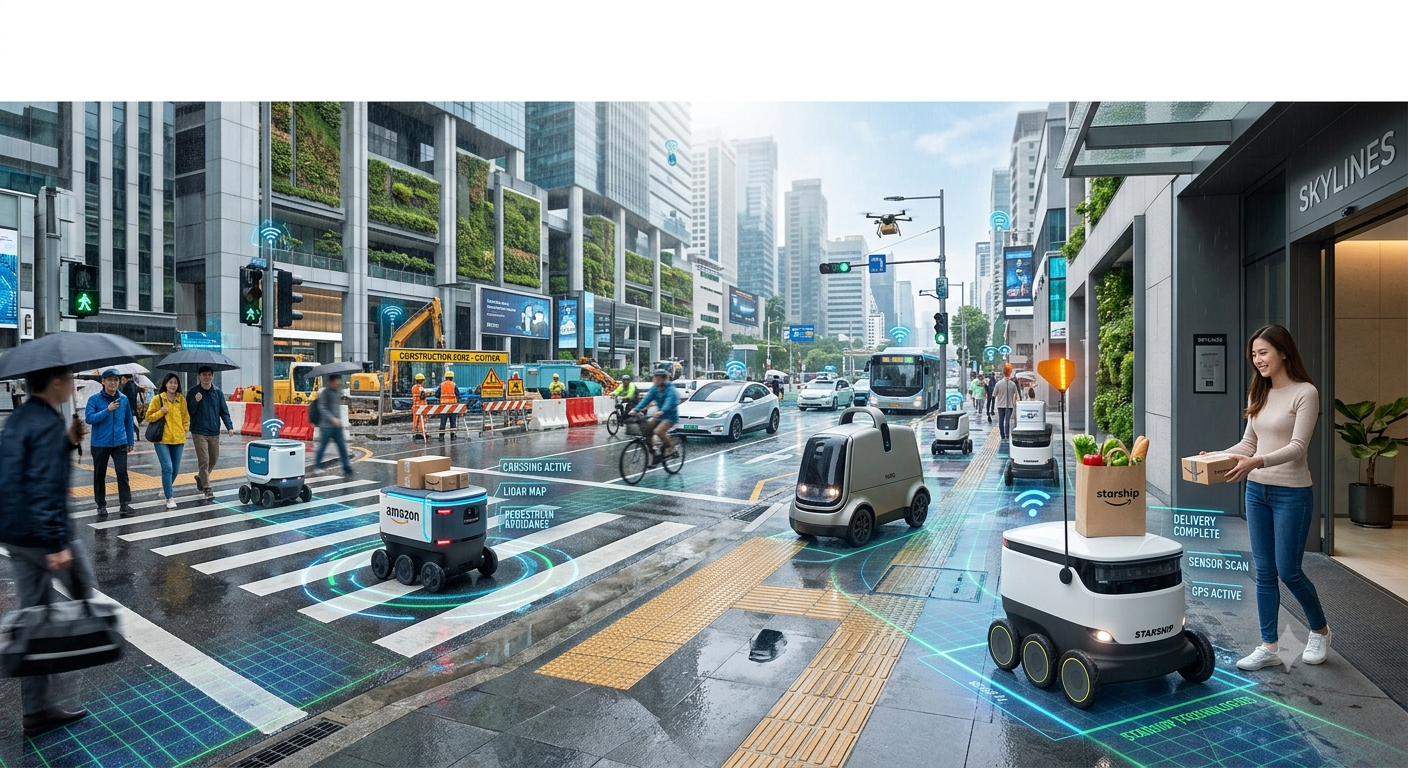
Delivery robots are no longer a futuristic concept they are rolling down sidewalks, navigating college campuses, and dropping off packages at front doors right now. As e-commerce explodes and consumer demand for faster, cheaper delivery grows, companies are turning to autonomous robots to bridge the gap. These compact, self-navigating machines promise to cut delivery costs, reduce traffic congestion, and eliminate the pressure on an already strained logistics workforce. But like any emerging technology, delivery robots come with real challenges that cannot be ignored. Understanding what these machines can do today, where they fall short, and where the technology is heading gives a clear picture of how profoundly they will reshape daily life.
The Real Benefits of Delivery Robots Why Businesses and Consumers Are Embracing Them
Delivery robots solve problems that traditional logistics systems have struggled with for years. Their advantages go beyond simple novelty they address genuine pain points in the modern supply chain.
Dramatically Lower Last-Mile Delivery Costs
Last-mile delivery the final leg of a package’s journey from a distribution hub to a customer’s door is the most expensive part of the entire logistics chain. It accounts for up to 53% of total shipping costs according to industry research. Delivery robots cut those costs significantly by replacing human drivers for short-distance, low-weight deliveries. Once deployed, a robot works around the clock without wages, breaks, or benefits making the economics extremely attractive for businesses operating at scale.
Faster and More Reliable Deliveries
Delivery robots follow optimized routes, avoid traffic delays, and operate on predictable schedules. For food delivery and pharmacy runs where timing matters this consistency translates directly into better customer satisfaction. Companies like Star ship Technologies and Nuro have demonstrated that robots can complete deliveries faster than traditional couriers in controlled environments, particularly in dense urban or campus settings.
Reduced Carbon Footprint
Most delivery robots run on electric power. Replacing gas-powered delivery vans with fleets of small electric robots significantly reduces carbon emissions per delivery. For cities struggling with air pollution and traffic congestion, autonomous delivery robots offer a cleaner, quieter alternative that aligns with sustainability goals. Several municipalities have already begun integrating robot-friendly policies into their urban planning frameworks.
Contact-Free and Hygienic Delivery
The COVID-19 pandemic accelerated interest in contactless delivery across the board. Delivery robots eliminate human-to-human contact entirely during the handoff process a feature that proved invaluable during lockdowns and remains appealing to health-conscious consumers. Customers simply unlock the robot’s compartment via a smartphone app and retrieve their order without interaction.
24/7 Availability
Unlike human couriers who need rest, delivery robots operate day and night. This opens the door to round-the-clock service models that were previously impractical or cost-prohibitive. Late-night pharmacy deliveries, early-morning grocery drops, and after-hours restaurant orders all become viable with autonomous fleets that never clock out.
Challenges Facing Delivery Robots and the Innovations Pushing Through Them
Despite their promise, delivery robots face significant technical, regulatory, and social hurdles. Acknowledging these challenges honestly is essential to understanding where the industry actually stands.
Navigation in Complex Environments
Delivery robots perform well in controlled, predictable settings college campuses, planned communities, and pedestrian-friendly streets. But real-world urban environments are messy. Construction zones, unpredictable pedestrian behavior, steep inclines, damaged pavements, and severe weather all disrupt autonomous navigation systems. Improving the machine learning algorithms that power robot decision-making remains one of the field’s biggest ongoing challenges.
Regulatory and Legal Barriers
Laws governing delivery robots vary widely by country, state, and city. Some jurisdictions welcome them with clear sidewalk-use regulations. Others ban them outright or leave their status legally ambiguous. Without consistent regulation, scaling delivery robot networks across different markets becomes complicated and expensive. Industry groups are actively lobbying for standardized frameworks, but progress moves slowly through legislative systems.
Security and Theft
A small, slow-moving robot carrying food or packages is an obvious target for theft or vandalism. Real-world incidents have already occurred in several cities. Manufacturers have responded with tamper-proof compartments, GPS tracking, remote monitoring, and onboard cameras but determined thieves remain a persistent concern, particularly in high-crime areas where delivery robots could actually provide the most benefit.
Public Acceptance and Pedestrian Safety
Not everyone welcomes delivery robots on shared sidewalks. Elderly pedestrians, wheelchair users, and parents with strollers have raised legitimate concerns about robots blocking pathways or behaving unpredictably. Building genuine public trust requires not just better technology but also transparent communication, thoughtful deployment strategies, and clear accountability when incidents occur.
Future Innovations Changing the Game
The next generation of delivery robots tackles today’s limitations head-on. Improved AI and sensor fusion technology allows robots to navigate more complex terrain with greater confidence. Drone-robot hybrid systems where drones handle aerial delivery and ground robots manage final handoff are already in testing phases. Companies are also exploring swarm delivery models, where multiple robots coordinate to fulfill large order volumes simultaneously. Meanwhile, advances in battery technology continue to extend range and reduce charging downtime, making robots viable for longer delivery distances than ever before.
Conclusion:
Delivery robots represent more than a technological novelty they signal a fundamental shift in how goods move through cities and reach people’s hands. The benefits are real, the challenges are solvable, and the innovations coming down the pipeline make the long-term trajectory clear. Businesses that embrace this technology early will gain a decisive competitive edge, while cities that plan proactively will enjoy cleaner, less congested streets. The robot revolution in last-mile delivery is not coming it is already here. For more in-depth coverage of emerging technologies, innovation trends, and insights that keep you ahead of the curve, visit DailyInfoRoom where the future makes sense today.












