


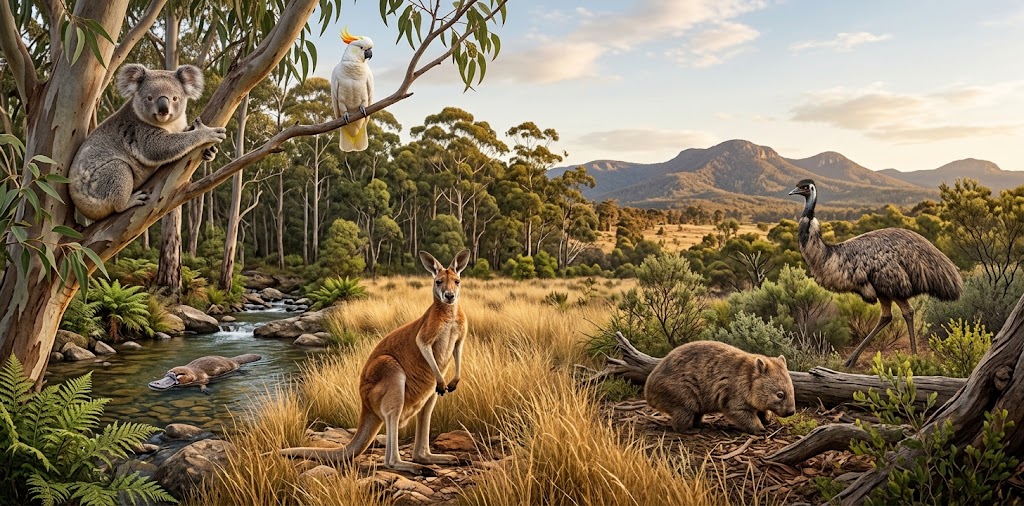
Australia’s Most Iconic wildlife captures the imagination of nature lovers, scientists, and travelers worldwide in a way that no other country’s fauna manages to replicate at comparable scale or uniqueness. Australia separated from the ancient supercontinent of Gondwana approximately 45 million years ago and spent tens of millions of years in biological isolation that produced an evolutionary experiment unlike anything occurring on any other landmass on earth. That isolation created animals that exist nowhere else in the world, filling ecological roles through body plans, reproductive strategies, and behavioral adaptations that evolution on other continents solved through entirely different biological solutions. Understanding Australia’s Most Iconic native animals reveals not just the remarkable creatures themselves but the extraordinary biological story that continental isolation writes across geological time.
Australia’s Most Iconic Mammals That Exist Nowhere Else on Earth
Australia’s Most Iconic wildlife status rests most powerfully on its extraordinary marsupial and monotreme mammals that represent evolutionary lineages found exclusively on the Australian continent and in closely related island ecosystems.
The Kangaroo: Australia’s Most Recognized Animal
The kangaroo stands as Australia’s Most Iconic animal internationally, representing the continent on the national coat of arms, currency, and virtually every piece of tourism imagery that promotes Australia to the world. Australia has more kangaroos than people. The kangaroo population in Australia is estimated at around 42.8 million, while Australia’s human population is just under 28 million.
Red kangaroos, the largest marsupials alive today, stand up to 2 meters tall and travel using a bipedal hopping locomotion powered by powerful hind legs that create one of the most energy-efficient forms of mammalian locomotion known to science. Kangaroos convert the elastic energy stored in their tendons during each landing into propulsive force for the next hop, meaning their energy expenditure actually decreases at higher speeds rather than increasing as it does for running mammals.
The distinctive quality that makes kangaroos Australia’s Most Iconic mammal extends beyond their unusual locomotion into their reproductive biology. Female kangaroos carry partially developed joeys in external pouches for months after birth, nursing the tiny newborns through developmental stages that placental mammals complete entirely inside the womb.
The Koala: The World’s Most Misunderstood Native
Koalas rank among Australia’s Most Iconic animals globally but remain one of the world’s most misunderstood. Despite the popular nickname “koala bear,” koalas are marsupials with no evolutionary relationship to bears whatsoever. They share the fundamental marsupial characteristic of carrying young joeys in external pouches and nursing them through extended developmental periods.
Koalas survive on a diet of eucalyptus leaves that most animals cannot digest because the leaves contain toxic compounds that koalas detoxify through specialized liver enzymes that evolved specifically to handle this dietary challenge. Eucalyptus provides minimal nutrition, which explains the koala’s famously sedentary lifestyle. Koalas sleep up to 22 hours daily to conserve the energy their low-nutrition diet barely provides.
The koala’s survival status makes it one of Australia’s Most Iconic animals facing genuine existential pressure. The International Union for Conservation of Nature listed the koala as endangered in 2022 following dramatic population declines driven by habitat destruction, disease, climate change effects on eucalyptus forests, and vehicle strikes.
The Platypus: Nature’s Most Improbable Creation
The platypus earns its place among Australia’s Most Iconic animals through a biological profile so unusual that European scientists who first examined a preserved specimen in 1799 believed it was a taxidermy hoax assembled from multiple different animals. When the first platypus skin reached Britain, scientists were convinced someone had stitched a duck’s bill onto a beaver-like body as an elaborate prank.
The platypus is one of only five living monotreme species that lay eggs despite being mammals. Male platypuses carry venomous spurs on their hind legs that deliver pain intense enough to disable a human limb temporarily. Platypuses hunt underwater using electroreceptors in their bills that detect the electrical fields generated by the muscle contractions of prey items, allowing successful hunting in complete darkness through a sensory system that no other mammal uses for food detection.
The Tasmanian Devil: The Island’s Ferocious Carnivore
The Tasmanian devil is the world’s largest carnivorous marsupial and one of Australia’s Most Iconic animals despite existing only on the island state of Tasmania following its extinction on mainland Australia approximately 3,000 years ago. Devils are known for their bone-crunching jaws, their blood-curdling screams during feeding disputes, and their ability to consume entire prey animals including bones, fur, and organs that leave nothing behind.
The species faces a devastating infectious cancer called Devil Facial Tumor Disease that spreads between animals during social contact and has reduced wild populations dramatically since its discovery in 1996. Conservation programs including the establishment of insurance populations in mainland zoos and disease-free island sanctuaries work to ensure the Tasmanian devil’s survival against this unusual pathogen.
Australia’s Most Iconic Birds and Reptiles That Complete the Wildlife Story
Australia’s Most Iconic wildlife extends well beyond mammals into bird and reptile species that demonstrate the same extraordinary evolutionary individuality that continental isolation produced across every vertebrate group that colonized and evolved within Australia’s diverse ecosystems.
The Emu: The World’s Second-Largest Bird
The emu stands as one of Australia’s Most Iconic birds and holds the distinction of being the world’s second-largest bird by height after the ostrich. Like kangaroos, emus appear on Australia’s national coat of arms specifically because both animals share the characteristic of being physically incapable of walking backward, symbolizing the national aspiration of moving only forward.
Emus reach heights of nearly two meters and weigh up to 60 kilograms, possessing powerful legs capable of running at 50 kilometers per hour and delivering kicks that can seriously injure predators and humans. Unlike most birds, male emus take exclusive responsibility for incubating eggs and raising chicks after females lay the clutches and then depart to seek additional mates.
The Great Emu War of 1932 remains one of Australia’s Most Iconic historical curiosities involving wildlife. The Australian military deployed soldiers armed with Lewis guns to reduce emu populations that were damaging wheat crops in Western Australia. The campaign ended in failure and embarrassment when the emus proved remarkably resistant to military tactics, leading to an official withdrawal that emu populations thoroughly won.
The Cassowary: The World’s Most Dangerous Bird
The southern cassowary claims the title of the world’s most dangerous bird and one of Australia’s Most Iconic wildlife species in the tropical rainforests of North Queensland. Cassowaries stand up to 1.8 meters tall, weigh up to 76 kilograms, and possess a distinctive casque on their heads alongside powerful legs armed with 12-centimeter dagger-like claws on their inner toes.
Cassowaries are capable of delivering fatal kicks and have injured and killed humans who approached too closely or provoked defensive responses. Despite their dangerous reputation, cassowaries play a critical ecological role as seed dispersers for hundreds of tropical rainforest plant species whose large seeds only cassowaries swallow whole and distribute across sufficient distances for forest regeneration.
The Saltwater Crocodile: The World’s Largest Reptile
The saltwater crocodile represents one of Australia’s Most Iconic reptiles and holds the distinction of being the world’s largest living reptile, reaching lengths of 6 to 7 meters and weights exceeding 1,000 kilograms in the largest confirmed specimens. Saltwater crocodiles inhabit the coastal areas, rivers, and estuaries of northern Australia from Western Australia through the Northern Territory to Queensland.
These ancient predators have remained largely unchanged for approximately 200 million years, making them living representatives of the prehistoric world that survived the mass extinction event that wiped out the non-avian dinosaurs. Their ambush hunting technique, extraordinary bite force estimated at over 16,000 Newtons, and ability to remain submerged for extended periods make them one of the world’s most effective apex predators in their aquatic environment.
The Kookaburra: The Sound of the Australian Bush
The laughing kookaburra is one of Australia’s Most Iconic birds not through visual spectacle but through the distinctive cackling call that generations of visitors and residents associate immediately with the Australian bush environment. Kookaburras are the world’s largest kingfishers and hunt not fish but small mammals, reptiles, insects, and other birds through a sit-and-wait predatory strategy from exposed perches.
Their territorial laugh serves as a dawn and dusk chorus that marks territory boundaries across family groups and creates the acoustic backdrop that film and television productions worldwide use to signal Australian setting, often inaccurately in contexts where kookaburras would not naturally occur.
Conclusion:
Australia’s Most Iconic wildlife represents an evolutionary treasure that continental isolation created across tens of millions of years of biological experimentation that produced animals found nowhere else on earth. Kangaroos, koalas, platypuses, Tasmanian devils, emus, cassowaries, saltwater crocodiles, and kookaburras collectively tell a biological story of adaptation, isolation, and evolutionary creativity that makes Australia the world’s most biologically distinctive continent by any comparative measure. Protecting these animals through conservation investment, habitat preservation, and climate action represents both an ecological responsibility and a cultural imperative for a nation whose international identity rests powerfully on the extraordinary wildlife that shares its continent. For more fascinating wildlife content, natural history exploration, travel guides, and science stories that expand your understanding of the living world, visit DailyInfoRoom where curiosity finds the knowledge it deserves every single day.