


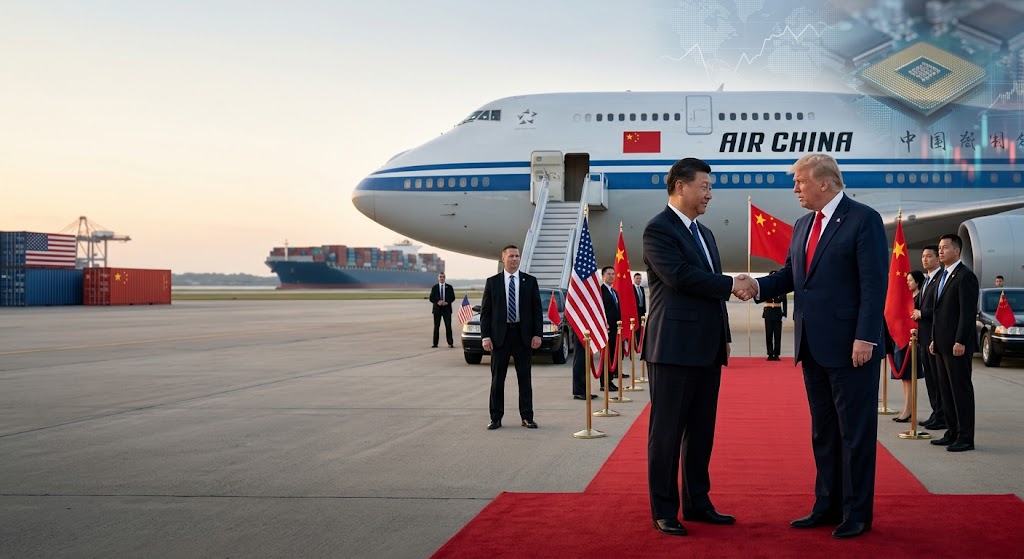
US President Donald Trump plans to personally welcome Chinese President Xi Jinping at Joint Base Andrews during Xi’s state visit to the United States from September 23 to 25, 2026. The unusual airport greeting reflects the importance of the meeting as Washington and Beijing manage tensions over tariffs, technology, rare earth minerals, Taiwan, and artificial intelligence. The two countries have moved away from the highest levels of their earlier tariff confrontation, yet major disagreements remain. Their existing trade truce will expire in November, creating pressure for both governments to keep negotiations active. The leaders now have an opportunity to discuss trade barriers, supply chains, agricultural purchases, and other economic issues.
Trump and Xi Face Major Trade Challenges
The Trump Xi meeting comes at a sensitive point in US China economic relations. Both countries remain major trading partners, but tariffs and restrictions have changed business conditions for companies in both markets.
The two governments reached a trade framework in May that aimed to reduce tensions and encourage cooperation. The agreement included plans for reciprocal tariff reductions worth about $30 billion and commitments involving agricultural and industrial trade. Progress has remained uneven across several parts of the agreement.
The tariff truce now faces another important deadline. Reuters reported that the arrangement could expire on November 10. Both governments therefore have an incentive to discuss ways to prevent another sharp increase in tariffs.
Trump has sought larger Chinese purchases of American products. Agricultural goods remain an important part of those discussions. Boeing aircraft could become another major topic because Washington wants China to follow through on aircraft purchase commitments.
China wants changes in several American trade and technology policies. Beijing has pushed Washington to ease restrictions that limit Chinese access to advanced American technology. Chinese officials have raised particular concerns about semiconductor and artificial intelligence restrictions.
Rare earth minerals create another major issue. China controls a large share of global rare earth processing and produces many materials that support electronics, automobiles, renewable energy equipment, and defense technology. Washington wants reliable access to these resources, while Beijing wants greater access to advanced American technology.
The two governments therefore enter the meeting with different priorities. Trump wants stronger American exports and improved market access. Xi wants fewer technology restrictions and stable economic relations. Their discussions will need to address these competing interests.
Can the Trump Xi Meeting Reduce Trade Tensions?
The phrase Avert Trade War captures one of the main concerns surrounding the summit, but the meeting does not guarantee a major trade agreement. Reuters reported that analysts expect the leaders to focus on maintaining stability rather than announcing a sweeping new deal.
The planned airport greeting carries diplomatic significance. Trump rarely personally greets visiting foreign leaders at the airport. The White House has planned an arrival ceremony, a military review, and a state dinner for Xi’s visit.
The personal relationship between the two leaders can help maintain communication, but economic disagreements remain complex. Trade negotiations involve government agencies, businesses, lawmakers, technology companies, farmers, manufacturers, and financial markets.
Both countries have strong economic reasons to maintain stable relations. American companies depend on Chinese manufacturing and supply chains for many products. Chinese companies depend on access to international markets, advanced technology, and major consumer economies.
Recent trade data shows the scale of the relationship. China recorded strong export growth in August 2026, with exports increasing by about 25 percent from the previous year. Chinese exports to the United States increased by 34.4 percent during the same month.
Technology will add another layer to the discussions. The United States and China compete strongly in artificial intelligence, semiconductor development, and advanced computing. Alibaba recently announced a new AI chip and plans for a much larger AI model, highlighting the rapid development of China’s technology sector.
Taiwan will create another sensitive issue. Reuters reported that Xi may ask Trump to stop American arms sales to Taiwan and refer to the 1982 US China joint communiqué. Washington maintains a different position and continues to provide support for Taiwan under US law.
Iran could enter the discussions as well. China maintains important economic relations with Iran, while the Trump administration faces an ongoing conflict involving Tehran. This issue adds another layer to the wider US China relationship.
The leaders therefore face several interconnected challenges. Trade affects technology. Technology affects national security. Rare earth minerals affect manufacturing. Taiwan affects diplomatic relations. Each issue can influence negotiations on the others.
A stable dialogue could help both governments manage disagreements. A breakdown in negotiations could create renewed uncertainty for businesses and financial markets. The outcome will depend on the commitments both sides make and the actions they take after the summit.
Conclusion: A Critical Moment for US China Trade Relations
Trump’s planned airport welcome for Xi Jinping highlights the importance of the upcoming US China summit. The two leaders face difficult disagreements over tariffs, technology, rare earth minerals, agricultural trade, and Taiwan. Both governments have reasons to protect economic stability, yet major differences remain. The November trade truce deadline adds pressure for continued negotiations. The meeting may produce limited agreements rather than a complete settlement of every dispute. The discussions can still help both sides manage tensions and keep communication open. Follow DailyInfoRoom for more informative coverage of global trade, international relations, business, and world news.












