


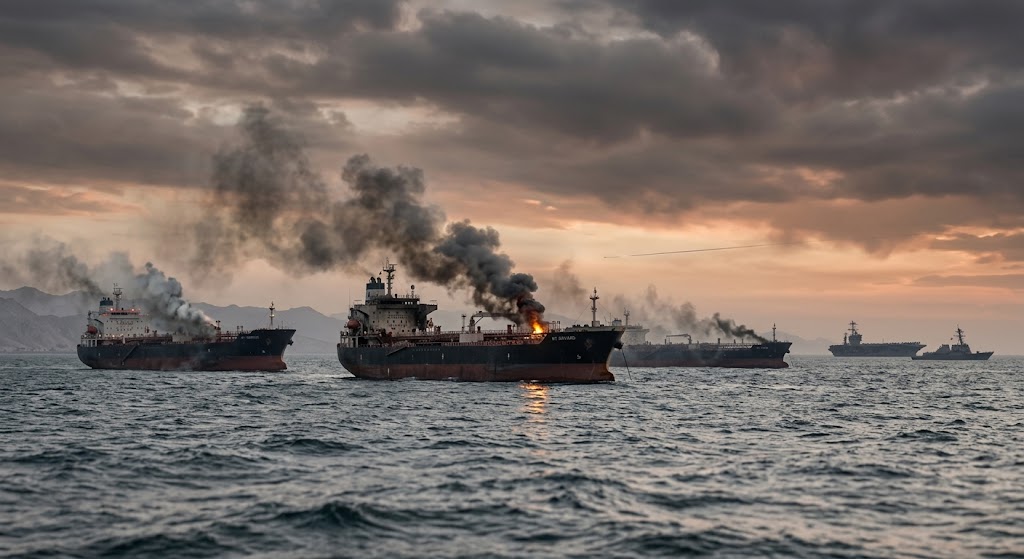
US Strikes three Iranian oil tankers on September 5, 2026, in a dramatic military escalation that follows Iranian ballistic missile attacks on two US Navy warships operating in the region. US forces struck three Iranian crude oil carriers after US Central Command said the Islamic Revolutionary Guard Corps launched ballistic missiles toward two Navy warships in the region. A US aircraft carrier and guided missile destroyer evaded multiple attacks by Iran’s Islamic Revolutionary Guard Corps before American forces retaliated with decisive strikes against Iranian oil infrastructure. No American personnel were harmed. The US Strikes permanently disabled two crude oil carriers and destroyed a third, delivering a clear military and economic message that Admiral Brad Cooper stated without ambiguity: if Iran shoots at American ships, the United States will strike Iranian vessels in return.
What Happened When US Strikes Hit the Three Iranian Oil Tankers
US Strikes on September 5, 2026, represent a significant escalation in the 2026 Iran-US conflict that began in late February and has progressively expanded the military confrontation between the two nations across every domain of the Persian Gulf and surrounding waters.
The Three Vessels Targeted by US Strikes
CENTCOM said US forces retaliated by permanently disabling two crude oil carriers. The M/T Downy was struck off the coast of Kharg Island and the M/T Stark 1 was hit near Jask. Forces also destroyed a third vessel, the M/T Kylo near the Gulf of Oman.
The Kylo was not carrying oil at the time and its crew was directed to abandon the vessel before American forces struck it in multiple locations, CENTCOM said. This crew warning before striking the unladen vessel demonstrates that US Strikes operations maintained specific rules of engagement around civilian casualties even during aggressive retaliatory action against Iranian military-linked assets.
Iranian state TV reported that four US missiles struck a tanker about six miles from Kharg Island, home to a terminal through which Iran exports most of its crude oil. Kharg Island has been repeatedly targeted during the conflict, including US strikes on military sites there in March 2026, though American forces deliberately avoided damaging oil infrastructure during those earlier operations.
CENTCOM’s “Tanker for Tanker” Warning
“If you shoot at two of our ships, we will impose an even higher economic cost, taking out three of yours,” Admiral Brad Cooper said in a statement following the US Strikes. He added: “We will not hesitate to defend American forces, and if necessary, destroy Iran’s limited and exposed oil fleet.”
That escalatory language signals that US Strikes policy has shifted from reactive defense to proactive economic warfare targeting Iranian oil export capability. The US military attacked Iranian government tankers as part of a new “tanker for tanker” policy approved by President Trump to further deter Iranian attacks on vessels moving through the Strait of Hormuz.
This policy represents the first time the US military has struck Iranian tankers in retaliation for Iranian attacks on ships in the Strait of Hormuz rather than to prevent them from violating the naval blockade. The distinction matters because it signals a deliberate strategic choice to escalate economic pressure on Iran’s primary revenue source through direct military action against oil export infrastructure.
Iran’s Response and Diplomatic Condemnation
In a statement carried by Iranian state media IRIB, the Iranian foreign ministry said the US Strikes attacks violated the United Nations Charter and constituted a war crime and a threat to international peace and commercial shipping. No casualties were reported according to Iran’s semiofficial Tasnim news agency.
Iranian media reported that a tanker near Kharg had been hit by US missiles and that its crew was being evacuated. The absence of casualties reflects the operational procedures that both sides appear to maintain around crew safety even as the military confrontation between their forces intensifies across the Persian Gulf region.
The Broader Context of US Strikes and What They Mean for Global Energy Security
US Strikes on Iranian oil tankers do not occur in isolation. They represent the latest escalation in a conflict that has effectively shut the Strait of Hormuz, disrupted global oil markets, and created economic pressure on every nation dependent on Persian Gulf energy exports since the conflict began in February 2026.
The Strait of Hormuz and Global Energy Consequences
The conflict between Iran and the United States has effectively shut the Strait of Hormuz, a key waterway for the world’s oil supply before the war. Iran is the third-largest producer in the Organization of the Petroleum Exporting Countries and exported 90% of its crude via Kharg Island before the war, with flows disrupted by a US blockade of Iranian oil exports which began in mid-April 2026.
The September 5 US Strikes against tankers operating near Kharg Island and in the Gulf of Oman expand the geographic scope of the naval confrontation and increase the risk exposure for commercial shipping in surrounding waters. Every escalation in the US-Iran naval conflict creates additional market uncertainty that oil prices immediately reflect through the premium that traders add to account for supply disruption risk in a region that historically supplies approximately 20% of global oil consumption.
Trump’s Escalatory Shift After “Small Potatoes” Comment
US Strikes on September 5 come a day after President Trump appeared to downplay the war with Iran as “small potatoes” during an exchange with reporters in the Oval Office. That contradiction between minimizing language one day and authorizing significant military strikes the next reflects the fluid and sometimes inconsistent communication pattern that has characterized American messaging throughout the 2026 Iran conflict.
Most recently, on August 31, Trump posted an artificial intelligence-generated video of Kharg Island being blown up. Trump threatened in June to seize Kharg Island as US forces continued military strikes against Iran. These public statements alongside operational US Strikes action create a deterrence communication pattern that military analysts describe as deliberately ambiguous to prevent Iran from accurately calibrating the threshold for American military response.
The Tanker for Tanker Policy and Its Strategic Logic
US Strikes under the new “tanker for tanker” policy target Iran’s economic lifeline rather than purely its military assets. Iran depends overwhelmingly on oil export revenues to fund government operations, military activities, and the economic activity that sustains public support for the conflict. Destroying or disabling Iranian oil tankers attacks this revenue stream in ways that purely military infrastructure strikes do not.
The US Strikes policy calculation holds that Iran will modify its military behavior if the economic cost of those behaviors rises high enough to threaten the financial stability that sustains the government’s broader strategic position. Whether that deterrence logic proves correct depends on whether Iran’s leadership prioritizes economic stability or military defiance when the two come into direct conflict through continued escalation.
A US official said the Iranians have not only lost control of the Strait of Hormuz, they have also lost control over the conflict. That assessment reflects American confidence that US Strikes establish escalation dominance in the current conflict phase, though the IRGC’s continued willingness to launch ballistic missiles at US Navy warships suggests Iranian military leadership does not accept that characterization of the strategic balance.
Diplomatic Efforts Running Parallel to US Strikes
The September 5 US Strikes occur within days of resumed diplomatic communication between Washington and Tehran through intermediaries seeking to establish a framework for conflict de-escalation. Iran’s president defended the memorandum of understanding with the United States as the best option for peace just days before Iranian forces launched the missile attacks that triggered the US Strikes retaliatory response.
This contradiction between presidential diplomatic defense of the negotiation framework and IRGC military action that undermines it reveals the internal division within Iran’s government about the appropriate response to American pressure. US Strikes that follow IRGC provocations rather than presidential diplomatic outreach create conditions where Iranian moderates who support negotiated resolution find their position weakened by military hardliners whose actions generate American responses that inflame domestic opinion against compromise.
Conclusion:
US Strikes on three Iranian oil tankers on September 5, 2026, represent a deliberate escalation in a conflict that has already shut the Strait of Hormuz, disrupted global energy markets, and created a sustained military confrontation that diplomatic efforts have failed to halt. The tanker for tanker policy signals that American military strategy now targets Iranian economic capability alongside military assets, raising the cost of continued IRGC attacks on US Navy vessels in ways that pure military-to-military deterrence has not achieved across months of escalating conflict. The world watches a confrontation that carries consequences for energy security, regional stability, and global economic conditions that extend far beyond the Persian Gulf waters where US Strikes and Iranian missiles continue their dangerous exchange. For comprehensive, accurate, and timely coverage of the Iran-US conflict, Middle East military developments, and the global security stories that shape energy markets and international stability, visit DailyInfoRoom where serious geopolitical journalism finds the readers who demand reliable reporting on the events that matter most.












