


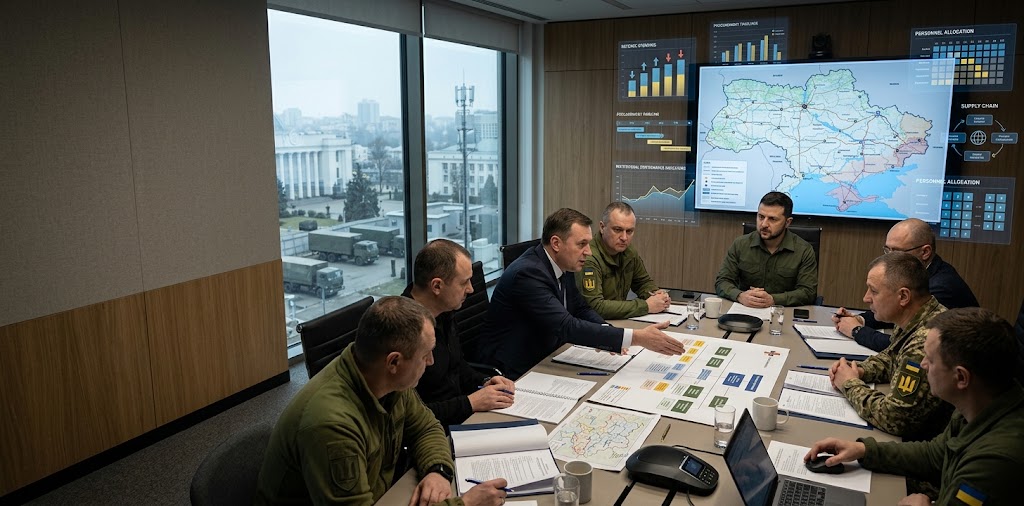
The Defense Ministry Crisis that erupted in July 2026 exposed fault lines within Ukraine’s wartime government that political analysts, military commanders, and ordinary Ukrainians had watched developing beneath the surface for months. Ukraine fought Russia’s more than four-year-old invasion under an interim defense minister, a day after a government reshuffle exposed a deep split between the military’s old guard and young innovators over how to fight the war. President Volodymyr Zelensky’s major shake-up of his government, which included the dismissal of Mykhailo Fedorov as defense minister and the appointment of a new prime minister, unsettled the country’s military leadership and triggered a public outcry. It tested Zelensky’s authority and was an unwelcome difficulty after Ukraine in recent months gained traction in the war. Understanding why this Defense Ministry Crisis happened, what it reveals about Zelensky’s leadership weaknesses, and what it means for Ukraine’s future requires honest, detailed analysis.
What Triggered the Defense Ministry Crisis and Why Fedorov’s Dismissal Shocked Ukraine
The Defense Ministry Crisis did not emerge from a single decision. It resulted from accumulated tensions within Zelensky’s inner circle that the July 2026 reshuffle brought into the open with consequences that no one in the presidential office fully anticipated.
Fedorov’s Six-Month Tenure and Growing Popularity
Ukrainian President Volodymyr Zelensky’s decision to push out Defense Minister Mykhailo Fedorov after just six months triggered an unusual backlash in wartime Ukraine, with soldiers, civil society activists, and even members of the president’s own party warning that the move risks derailing military reforms at a critical point in the war.
Fedorov was not simply another cabinet official. He built Ukraine’s drone warfare capability into one of the most effective asymmetric military programs in modern conflict history. His background in technology, his relationships within Ukraine’s defense innovation community, and his ability to translate military operational needs into procurement decisions made him uniquely valuable at a moment when drone warfare defines the conflict’s daily character.
A recent survey by the Kyiv Institute of International Sociology revealed that public trust in Fedorov surged from 38 percent to 50 percent over the last six months. Rising public trust in a cabinet minister during wartime represents a political resource that any leader manages carefully. Zelensky chose to eliminate it rather than leverage it, and the Defense Ministry Crisis that followed demonstrated the cost of that miscalculation.
The Old Guard Versus Innovators Divide
The government reshuffle exposed a deep split between the military’s old guard and young innovators over how to fight the war. This generational and doctrinal divide sits at the heart of the Defense Ministry Crisis. Ukraine’s military command structure contains senior officers trained in Soviet and post-Soviet doctrinal frameworks that prioritize conventional force-on-force engagement, territorial control through manpower, and hierarchical command structures that resist rapid adaptation.
Analysts say Fedorov had clashed with Ukraine’s military chief, General Oleksandr Syrskyi, over priorities. The specific nature of these clashes reflected the broader doctrinal divide. Fedorov prioritized drone production, autonomous systems, and technology-enabled warfare that reduces Ukrainian casualty exposure while increasing strike effectiveness against Russian logistics and command infrastructure. Syrskyi prioritized conventional mobilization, front-line reinforcement, and territorial defense through manpower-intensive positions.
Both approaches address real military needs. The Defense Ministry Crisis exposed the failure to build a governance structure that integrates both perspectives rather than forcing a zero-sum competition between them that Zelensky resolved by removing the innovation advocate.
The Syrskyi Factor and Command Dysfunction
The former defense minister made a blistering attack on Syrskyi in his news conference on Thursday. “You cannot solve the mobilization issue unless there are real changes in the military. What are we offering? Lies, chaos,” he said. The idea that “Syrskyi can hold the frontline is a fake,” Fedorov added. “Instead of coming up with how to win over Russia, he came up with how to split the country.”
These are extraordinary public statements from a recently dismissed defense minister about a sitting commander-in-chief during active wartime. The venom of Fedorov’s assessment of Syrskyi reveals that the Defense Ministry Crisis reflected not merely policy disagreements but genuine personal animosity and institutional dysfunction at the highest levels of Ukraine’s military governance structure.
Zelensky acknowledged the protests Thursday and said “the problem lies not only with the parties, but with me as well.” This admission of personal responsibility for the institutional breakdown represents a rare moment of presidential self-criticism that the scale of the public response apparently compelled Zelensky to offer publicly.
What the Defense Ministry Crisis Reveals About Zelensky’s Political Weaknesses
The Defense Ministry Crisis exposed specific leadership vulnerabilities that operate below the surface of Zelensky’s public image as a wartime leader of uncommon courage and communication skill.
The Pattern of Removing Popular Officials
The political analyst said Zelensky values unity inside his team and has a history of eventually removing officials who become centers of internal conflict. That may help explain why Fedorov, despite remaining one of the administration’s most recognizable and popular officials, became expendable.
This pattern reveals a leadership style that prioritizes personal loyalty and internal cohesion over institutional effectiveness and public credibility. Zelensky removes officials who develop independent political capital rather than officials who underperform against measurable objectives. The Defense Ministry Crisis demonstrates that this approach creates political vulnerabilities that manifest most dangerously when the official removed commands genuine public affection and military respect simultaneously.
“Changing the defense minister every six months is not appropriate during a war,” the analyst noted. “Many people now regard this position as an electric chair. The problems and challenges Fedorov faces will also confront another minister.”
The institutional damage that frequent leadership changes create at the Defense Ministry extends beyond any individual’s departure. Each dismissal disrupts ongoing procurement negotiations, reform program timelines, and the trust-building with international partners that effective defense ministry leadership requires over sustained periods. The Defense Ministry Crisis represents the cumulative institutional cost of treating one of Ukraine’s most critical ministries as a political management tool rather than a strategic capability to protect and develop.
Street Protests During Wartime
People attended a rally to protest the dismissal of defense minister of Ukraine Mykhailo Fedorov after being at post for six months in Kyiv, Ukraine, on July 20, 2026. Wartime street protests against a president who built his political identity around wartime national unity represent a significant departure from the public posture that Ukraine maintained through the most difficult periods of the conflict.
The Defense Ministry Crisis produced protest at a moment when Ukraine had gained battlefield momentum. Citizens who accepted extraordinary wartime restrictions on political life in exchange for focused national defense effort drew a line when they perceived that leadership dysfunction rather than enemy action threatened the military capability sustaining that defense.
The Resignation Cascade
Prime Minister Yulia Svyrydenko resigned at Zelensky’s request, triggering the automatic dissolution of her cabinet. Combining a prime ministerial resignation with a defense ministry dismissal in a single government shake-up doubled the institutional disruption that Ukraine’s wartime government absorbed simultaneously. The Defense Ministry Crisis became inseparable from a broader governance crisis that raised questions about the stability of decision-making at Ukraine’s highest levels.
Bowing to a demand from protests unleashed by his short-sighted decision to fire Ukraine’s defense minister, President Zelensky appointed Major General Mykhailo Drapatyi, 43, to replace the controversial General Oleksandr Syrskyi as commander-in-chief. Drapatyi is widely respected and part of a new generation of officers molded by war with Russia rather than the Soviet system.
The appointment of Drapatyi following mass protests represents Zelensky bowing to public pressure in a way that strengthens both the protesters’ position and the incoming commander’s legitimacy through popular demand rather than presidential confidence. The Defense Ministry Crisis inadvertently produced the command reform that defenders of Ukraine’s innovation-focused military approach had sought for months.
International Partner Concerns
The Defense Ministry Crisis raised alarm among Ukraine’s Western supporters who monitor governance stability as a condition for continued large-scale military and financial assistance. Partners who provide billions in annual support need confidence that the institutional structures managing that assistance function with consistent leadership and clear accountability. Frequent senior leadership changes at the Defense Ministry create exactly the institutional instability that accountability frameworks cannot effectively engage with over short tenures.
Conclusion:
Ukraine’s Defense Ministry Crisis exposed genuine weaknesses in Zelensky’s leadership approach that wartime solidarity had previously obscured from international view. The pattern of removing popular officials who develop independent credibility, the tolerance of institutional dysfunction between the Defense Ministry and military command, and the failure to build governance structures that integrate innovation advocates and conventional military expertise all contributed to a crisis that public protests ultimately forced toward a resolution that better serves Ukraine’s military needs. Zelensky’s admission of personal responsibility represents the beginning of a reckoning with leadership vulnerabilities that Ukraine’s survival requires addressing honestly. For comprehensive coverage of Ukraine’s political developments, military affairs, and the global security stories that shape our world, visit DailyInfoRoom where serious journalism finds the readers who demand clarity and accuracy.












