


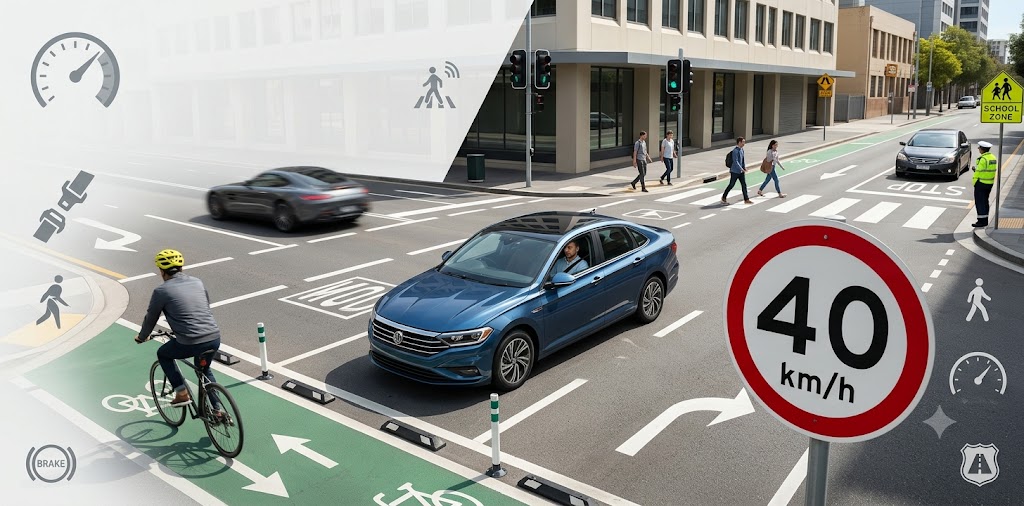
Slow Down, Save Lives is not a slogan painted on road signs for aesthetic purposes. It represents one of the most urgent and evidence-backed messages in modern public health and road safety science. Speed kills with a mathematical certainty that no driving skill, vehicle technology, or reaction time can fully overcome. The World Health Organization confirms that road traffic crashes kill approximately 1.35 million people every year and injure tens of millions more. Speed contributes directly to a significant proportion of those deaths in every country on earth regardless of road infrastructure quality, vehicle safety standards, or enforcement capacity. Every driver who chooses to exceed posted speed limits makes a decision that places their own life and every other road user’s life at measurable, documented risk.
The Science Behind Slow Down, Save Lives and Why Speed Kills With Mathematical Certainty
The message Slow Down, Save Lives carries weight that goes far beyond traffic law compliance. Physics, biology, and decades of crash data all confirm that speed amplifies both the probability of crashes occurring and the severity of injuries when crashes happen.
Speed and Stopping Distance Create Unavoidable Physics Problems
Every driver who exceeds a speed limit removes the stopping distance buffer that road engineers calculated when designing that specific road at that specific limit. A vehicle traveling at 50 kilometers per hour requires approximately 35 meters to stop completely after a driver perceives a hazard and begins braking. At 70 kilometers per hour, that stopping distance extends to approximately 65 meters. At 100 kilometers per hour, stopping distance exceeds 100 meters under ideal dry road conditions.
The Slow Down, Save Lives principle becomes numerically undeniable when drivers consider that hazards rarely appear 100 meters ahead with clear warning. Children run into roads from behind parked vehicles. Animals cross highways without warning. Vehicles brake suddenly in traffic queues that form around blind corners. Every kilometer per hour above the speed limit reduces the gap between when a driver perceives a hazard and when physics determines whether the vehicle stops before impact occurs.
Impact Force Increases Exponentially With Speed
The energy released during a vehicle collision does not increase proportionally with speed. It increases with the square of the speed, meaning that doubling speed quadruples the impact energy that vehicle occupants, pedestrians, and cyclists absorb during a crash. Slow Down, Save Lives directly addresses this exponential relationship between speed and injury severity that makes high-speed crashes so disproportionately lethal compared to low-speed collisions.
Research confirms that a pedestrian struck by a vehicle traveling at 30 kilometers per hour survives in approximately 90% of cases. At 50 kilometers per hour, that survival rate drops to approximately 20%. At 80 kilometers per hour, survival becomes statistically rare. The same human body absorbing the same physical impact from the same vehicle produces dramatically different outcomes based purely on the speed at which the vehicle traveled before striking. Slow Down, Save Lives captures this physics reality in four words that every driver should internalize before every journey.
Speed Reduces Reaction Time Effectiveness
Human reaction time averages approximately 1.5 seconds between perceiving a hazard and initiating a braking response. At 60 kilometers per hour, a vehicle covers approximately 25 meters during that 1.5-second reaction window before braking even begins. At 100 kilometers per hour, the same vehicle covers over 40 meters before the driver’s foot reaches the brake pedal.
The Slow Down, Save Lives message recognizes that human biology cannot be upgraded the way vehicle technology improves. Reaction time has biological limits that no training fully overcomes. Speed management remains the only reliable tool for keeping the gap between hazard perception and vehicle stop within the distance that road environments actually provide.
Speed Limits Represent Engineering Knowledge Not Arbitrary Restrictions
Every posted speed limit reflects traffic engineering analysis of road geometry, pedestrian activity, intersection density, visibility conditions, and vehicle mix that determines the maximum safe operating speed for that specific road section. Drivers who treat speed limits as suggestions rather than safety specifications ignore the engineering knowledge that produced those limits through systematic analysis of crash data, road geometry, and human factors research.
Slow Down, Save Lives means trusting the engineering process that established the limit on any given road rather than substituting individual confidence for systematic safety analysis. Experienced drivers who feel capable of safely exceeding posted limits on roads they know well consistently overestimate their hazard perception capability and underestimate the additional stopping distance that higher speeds demand in unexpected situations.
Practical Reasons Every Driver Must Embrace Slow Down, Save Lives on Every Journey
Understanding why speed kills is necessary but insufficient. Drivers need concrete practical reasons to actively choose the Slow Down, Save Lives approach on every journey rather than treating it as advice that applies to other, less skilled or experienced road users.
Over Speeding Destroys Families Not Just Statistics
Every road fatality statistic represents a real person whose death devastates a family, a workplace, a school, and a community in ways that never fully heal. Children lose parents. Parents bury children. Spouses face sudden widowhood. Friends lose people whose absence reshapes their social world permanently. The Slow Down, Save Lives principle asks every driver to connect the abstract number of road deaths to the concrete human reality of grief that each one generates.
Drivers who genuinely internalize this human cost think differently about the minutes they save by exceeding speed limits. Reaching a destination three minutes earlier through consistent over speeding represents a trade involving real risk to real people for a time saving that delivers no meaningful life improvement on any journey that does not involve a medical emergency.
Legal Consequences of Over Speeding Carry Serious Life Impact
Every country and jurisdiction applies serious legal consequences to over speeding that extend far beyond fine payments. License suspensions remove driving privileges that many people depend on for employment access. Criminal charges for dangerous driving or causing death by dangerous driving create permanent criminal records that affect employment prospects, international travel, professional licensing, and family life for years or decades after a single crash moment.
Drivers who choose to Slow Down, Save Lives protect themselves from these cascading legal consequences alongside protecting road safety for other users. The legal system treats speed-related crashes involving serious injury or death with increasing severity in jurisdictions worldwide as public tolerance for preventable road deaths continues declining.
Over Speeding Destroys Vehicle Systems Designed for Safe Operating Ranges
Modern vehicles incorporate safety systems including anti-lock braking, electronic stability control, lane departure warning, and automatic emergency braking that engineers calibrate for operation within posted speed limits. These systems deliver their designed safety benefits most effectively when vehicles operate within the speed ranges that system testing validated during development.
Over speeding reduces the effectiveness of every active safety system in a modern vehicle by creating situations where physics exceeds the intervention capacity that engineers designed into those systems. Slow Down, Save Lives means keeping vehicles operating within the speed ranges where their built-in safety technology actually protects occupants as intended rather than becoming insufficient in the face of speeds that overwhelm their intervention capability.
School Zones and Residential Areas Demand Absolute Speed Compliance
School zones and residential streets concentrate pedestrian vulnerability at its highest levels by mixing vehicle traffic with children whose road safety awareness, spatial judgment, and reaction speed all fall significantly below adult levels. A Slow Down, Save Lives commitment in these specific environments carries the highest possible impact per kilometer traveled at appropriate speed.
Children act unpredictably near roads. They chase balls into streets. They step from behind parked vehicles without checking for traffic. They cross between cars without using designated crossing points. Low speeds in school zones and residential areas give drivers the stopping distance and reaction time that unpredictable child behavior demands. No time saving justifies the risk that over speeding creates in areas where children move near vehicle traffic throughout the day.
Driver Fatigue Combines With Speed to Create Lethal Combinations
Fatigued drivers experience reaction times that research equates to legal blood alcohol impairment. Fatigue reduces hazard perception, narrows peripheral vision, and impairs the split-second judgment that avoiding crashes demands. Combining driver fatigue with speed removes two independent safety margins simultaneously, creating crash risk that exceeds either factor’s individual contribution.
The Slow Down, Save Lives principle has particular urgency for drivers experiencing fatigue because reduced speed provides additional reaction time that compensates partially for fatigue-related cognitive impairment. Tired drivers who maintain or exceed speed limits operate with essentially no safety margin between hazard appearance and inevitable impact on any unexpected situation requiring emergency response.
Conclusion:
Slow Down, Save Lives carries the weight of millions of preventable deaths, countless devastated families, and decades of crash research that all reach the same conclusion with remarkable consistency. Speed kills, speed injures, and speed destroys in ways that no vehicle technology, driving skill, or safety equipment fully compensates for at the point of impact. Every driver who actively chooses to respect speed limits on every journey makes a genuine contribution to reducing the road death toll that communities across the world continue absorbing as a preventable tragedy. The choice to slow down costs minutes. The choice to speed can cost lives. Make the right decision on every road, on every journey, every single time. For more road safety guides, health content, and practical knowledge that protects lives and improves daily decisions, visit DailyInfoRoom where information that matters finds the readers who act on it.












