


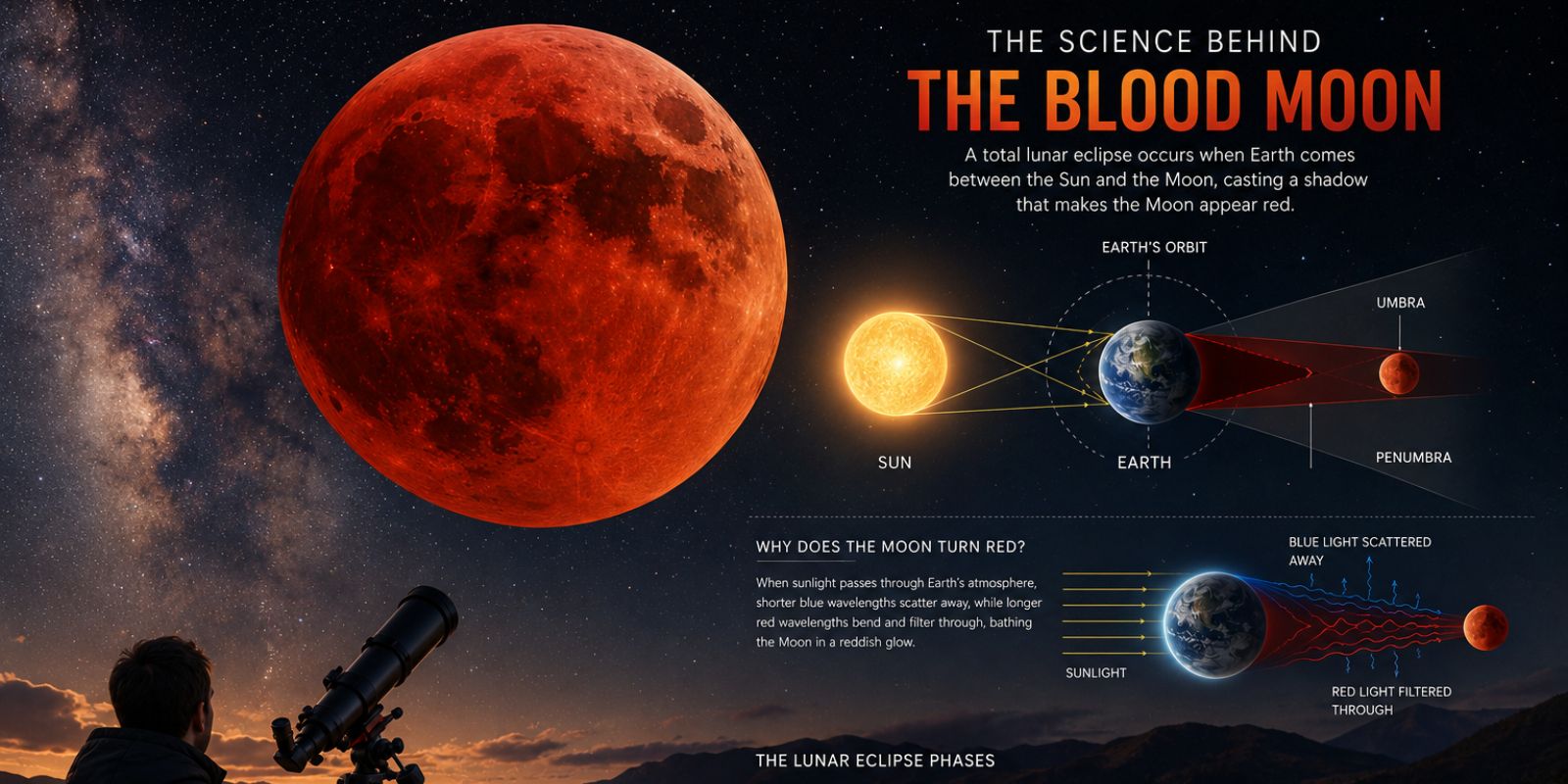
What’s behind the Blood Moon is a question that has fascinated humans for thousands of years. Ancient civilizations saw it as an omen of war, disaster, or divine anger. Today, science gives us a far more elegant explanation — and honestly, the truth is just as awe-inspiring as the myths. A Blood Moon occurs during a total lunar eclipse, when Earth positions itself directly between the Sun and the Moon, casting a deep reddish glow across the lunar surface. No special equipment is needed to witness it, making it one of the most accessible and breathtaking astronomical events anyone can experience. Understanding the science behind it makes the spectacle even more remarkable..
The Astronomy Explained What’s Behind the Blood Moon Scientifically
To understand what’s behind the Blood Moon, you need to understand how light, shadow, and planetary alignment work together to create this stunning visual phenomenon.
The Total Lunar Eclipse Connection
A Blood Moon is not a separate astronomical object or event it is specifically what happens during a total lunar eclipse. This occurs when the Sun, Earth, and Moon align perfectly in a straight line, with Earth sitting squarely in the middle. The Moon passes through Earth’s umbra the darkest, most central part of Earth’s shadow and the result is a dramatic transformation in the Moon’s appearance.
Unlike a solar eclipse, which lasts only minutes and requires precise positioning to observe, a total lunar eclipse unfolds slowly over several hours and remains visible across an entire hemisphere. That accessibility makes Blood Moons a favorite event for both amateur stargazers and professional astronomers alike.
Why the Moon Turns Red
Here is where the science becomes genuinely beautiful. When Earth blocks direct sunlight from reaching the Moon, the Moon does not simply go dark. Instead, Earth’s atmosphere bends and filters sunlight around the edges of the planet a process called Rayleigh scattering. This is the same optical process that paints sunrises and sunsets in rich oranges and reds.
The filtered light that reaches the Moon carries mostly red and orange wavelengths, since shorter blue wavelengths scatter away in the atmosphere. That reddish light then falls on the lunar surface, bathing the Moon in a deep crimson or burnt-orange glow that can range from bright copper to dark blood red depending on atmospheric conditions.
Essentially, every sunrise and sunset on Earth simultaneously projects onto the Moon’s surface during a total lunar eclipse. That is what’s behind the Blood Moon the collective light of every dawn and dusk on Earth, bent and cast across 384,000 kilometers of space.
What Affects the Shade of Red
Not every Blood Moon looks the same. The depth and richness of the red color depends directly on Earth’s atmospheric conditions at the time of the eclipse. A cleaner atmosphere produces a brighter, more vivid orange-red. An atmosphere heavy with dust, volcanic ash, or wildfire smoke scatters more light and produces a darker, murkier red sometimes pushing the Moon toward deep brown or charcoal gray at its edges.
After major volcanic eruptions, Blood Moons have historically appeared unusually dark. The 1992 eruption of Mount Pinatubo in the Philippines caused one of the darkest total lunar eclipses on record the following year
Blood Moons Through History Myths, Meanings, and Modern Significance
Understanding what’s behind the Blood Moon scientifically is one dimension of the story. The other dimension is the profound cultural and historical impact this event has had across human civilization.
Ancient Interpretations Across Cultures
Before telescopes and modern astronomy, a Blood Moon triggered fear and wonder in equal measure. Ancient Mesopotamian astronomers viewed total lunar eclipses as threats to the king and developed elaborate rituals to ward off disaster during their occurrence. The Inca civilization in South America believed a jaguar was attacking and devouring the Moon, prompting crowds to make loud noise and throw spears skyward to frighten the beast away.
In ancient China, the event was similarly interpreted as a dragon consuming the Moon. Communities would bang drums and shoot arrows into the sky in response. These reactions, though rooted in mythology, reflect just how powerfully the Blood Moon captured human imagination across independent cultures separated by thousands of miles.
Norse, Greek, and Hebrew traditions all carry references to lunar eclipses wrapped in symbolic language connecting the reddened Moon to divine signs, coming changes, or cosmic battles. Understanding what’s behind the Blood Moon reveals how universal the human impulse is to find meaning in the sky above.
The Four Blood Moons Tetrad Events
Occasionally, four consecutive total lunar eclipses occur in a row with no partial eclipses in between a sequence called a tetrad. These rare patterns have historically attracted enormous attention, particularly in religious communities. The 2014–2015 tetrad coincided with significant Jewish holidays, sparking widespread discussion in theological circles and mainstream media about prophetic significance.
Science places no special meaning on tetrads beyond their astronomical rarity, but their cultural resonance demonstrates how deeply Blood Moon events continue to affect human thought and conversation even in the modern era.
Blood Moons in Modern Science
Contemporary astronomers use total lunar eclipses as valuable research opportunities. By studying how sunlight filters through Earth’s atmosphere and reflects off the Moon, scientists can analyze atmospheric composition and model what exoplanet atmospheres might look like from a distance. In a remarkable way, observing a Blood Moon from Earth mirrors the technique astronomers use to study planets orbiting distant stars.
NASA and space agencies around the world track and predict lunar eclipses decades in advance, making Blood Moon forecasting one of the most precise exercises in modern astronomy. Future Blood Moons are predictable to the minute a testament to how thoroughly science has answered the question of what’s behind the Blood Moon.
When to Watch the Next One
Blood Moons occur several times per decade, though their visibility depends on your location. Astronomy apps and websites publish eclipse calendars well in advance, making it easy to plan ahead. No telescope is required just a clear sky, a comfortable spot outdoors, and a willingness to look up. The experience of watching the Moon slowly shift from silver-white to deep red in real time remains one of the most memorable things any person can witness with their own eyes.
Conclusion:
What’s behind the Blood Moon is both a scientific marvel and a mirror into human history. The same event that once drove ancient civilizations to bang drums and fire arrows into the sky now gives modern scientists a window into atmospheric science and exoplanet research. The reddish glow is nothing more and nothing less than the light of every sunrise and sunset on Earth, bending through the atmosphere and landing softly on the lunar surface. Simple physics, extraordinary beauty. Next time a Blood Moon graces the night sky, look up and appreciate both the science and the story. For more captivating content on astronomy, science, and the world around you, visit DailyInfoRoom where every topic worth knowing finds a home.












