


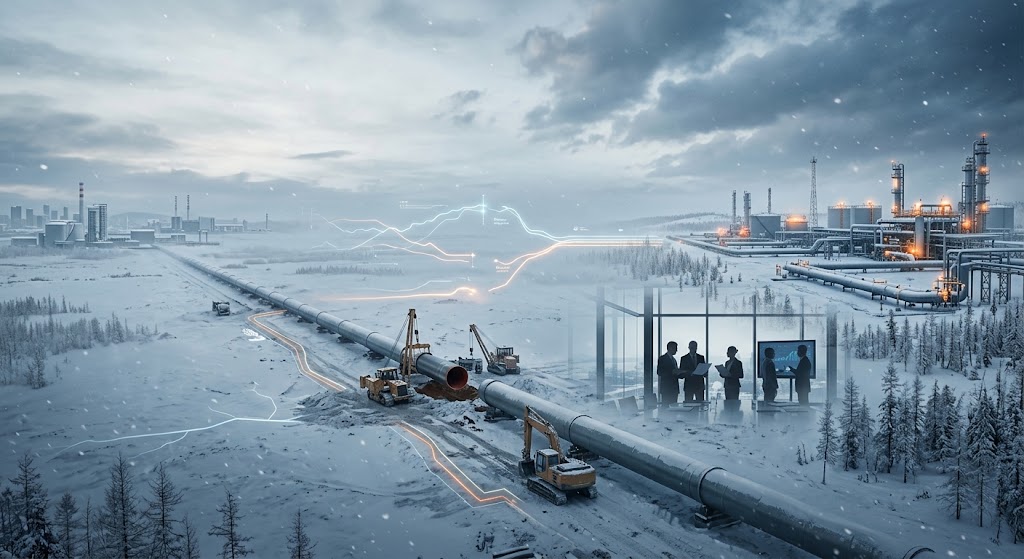
Russia and China Clash over natural gas pricing in a dispute that exposes the fundamental tension between geopolitical alliance narratives and commercial reality that no summit communiqué can paper over indefinitely. The Power of Siberia 2 pipeline, a 2,600-kilometer project that would carry 50 billion cubic meters of gas annually from Russia’s Yamal fields through Mongolia into northern China, sits at the center of the most consequential energy negotiation in the world today. Power of Siberia 2 has hit a deadlock, with a gas-price gap so vast that Beijing has told Moscow to stop raising the subject altogether. Neither side has formally walked away, but no timeline for a deal or for construction to begin is in sight. This Clash reveals how much the “no limits” partnership between Moscow and Beijing depends on whose interests align and whose do not.
The Pricing Gap at the Heart of the Russia-China Clash
The Russia-China Clash over Power of Siberia 2 pricing did not emerge suddenly. It reflects a fundamental disagreement about the commercial terms that one of the world’s most strategically significant energy infrastructure projects would operate under across decades of gas delivery.
What Russia Wants and What China Is Offering
China reportedly wanted pricing terms for the new pipeline to match Russia’s domestic rate of around $120-130 per 1,000 cubic meters, while Moscow is seeking terms closer to Power of Siberia 1, which analysts estimate would more than double that figure.
This pricing Clash captures the full commercial distance between the two sides. In 2025, China paid an average of around $258 per thousand cubic meters for Russian pipeline gas, already well below what Europe once paid. Beijing’s new demand pushes the discount much farther. Even Belarus has never been offered terms this close to Russia’s domestic price. This is no longer ordinary commercial bargaining.
Russia’s position reflects its economic needs. For Russia, the project is seen as key to redirecting part of the export volumes lost after the collapse of gas exports to Europe toward China. Moscow lost its primary energy customer when European sanctions and the Ukraine conflict drove a wholesale shift away from Russian gas. China represents the only buyer with the scale to absorb the volumes Russia needs to sell to sustain Gazprom’s revenue base.
China’s position reflects strategic confidence. Beijing’s strategy is to wait. By stalling, the Chinese leadership hopes to sign a deal on highly favorable terms once Russia’s economic leverage deteriorates further.
The Summit That Exposed the Clash
The May 2026 Putin-Xi summit in Beijing illustrated how deep the Clash runs beneath the public display of partnership. The Power of Siberia-2 project was conspicuously absent from the 42 bilateral agreements signed during the summit, casting doubt on a legally binding memorandum announced by Putin and Gazprom Chief Executive Alexey Miller in September 2025.
In July 2026, reporting indicates that Chinese representatives communicated to Russian counterparts prior to a high-level meeting in Beijing that Power of Siberia 2 should not be placed on the formal agenda, given the continued distance between the two sides on commercial terms.
China telling Russia not to put its most important energy project on the diplomatic agenda represents a significant rebuke that the Clash’s severity fully explains. Beijing holds the leverage in this negotiation and exercises it without diplomatic softening.
Why China Holds All the Cards in This Clash
Industry experts suggest Beijing’s hesitation is rooted in strategic diversification. China has access to ample global gas supplies and expects its import demand to peak by the mid-2030s, reducing the appeal of a project that will take six years to build.
China holds around 1.23 billion barrels in onshore crude inventory — sufficient for roughly 92 days of refining needs. Its domestic gas output also rose 2.7% in the first four months of the year, with central Asian pipelines, other than the Russian system, providing additional supply.
The Clash therefore occurs in an asymmetric negotiating environment where Russia needs the deal more urgently than China does, creating the patience advantage that Beijing exploits through deliberate delay.
What the Russia-China Gas Clash Means for Global Energy and the “No Limits” Partnership
The Clash over Power of Siberia 2 pricing carries consequences that extend well beyond the commercial dispute itself into the geopolitical relationship, global energy markets, and Russia’s long-term economic strategy.
The “No Limits” Partnership Meets Commercial Reality
Both governments have a strategic interest in avoiding public declarations that negotiations have failed. Russia cannot afford to signal that its most important gas export project has no viable buyer.
This mutual interest in avoiding public acknowledgment of the Clash creates the strange situation where both governments maintain partnership rhetoric while the commercial relationship at the partnership’s energy core remains unresolved at fundamental level. Public statements celebrate the bilateral relationship while private negotiations reveal a Clash that neither side can resolve without one party accepting commercially unfavorable terms.
The European Union has committed to phasing out all Russian liquefied natural gas imports by the end of 2026, with a full ban on pipeline gas from October 2027. Beijing has resumed buying American LNG. The first United States LNG cargo in a year had arrived at a Chinese terminal, following a resumption of purchases after President Xi Jinping and US President Donald Trump met in mid-May.
China resuming American LNG purchases while maintaining the Clash with Russia over Power of Siberia 2 pricing sends an unmistakable signal about Beijing’s energy strategy. China actively diversifies its supply sources rather than accepting dependence on Russian gas at prices Moscow considers commercially necessary. The Clash accelerates this diversification by removing any urgency from Beijing’s decision-making about Russian gas supply.
Russia’s Diminishing Energy Leverage
The Clash occurs against a background of steadily eroding Russian negotiating leverage that the passage of time only worsens. Russia’s European gas market has effectively closed, its sanctions-pressured economy constrains investment alternatives, and Gazprom requires the Power of Siberia 2 revenue pipeline to replace the European income that geopolitical developments eliminated from its business model.
The gap between geopolitical narrative and commercial reality defines the fundamental tension that politicians rarely acknowledge openly.
Every month of the Clash without resolution costs Russia more than it costs China. Gazprom’s revenues depend on finding buyers for Yamal gas at prices that sustain the company’s financial position. China’s diversified supply options allow Beijing to maintain the Clash indefinitely without energy security consequences that would create political pressure to compromise.
Power of Siberia 1 delivered approximately 38 billion cubic meters of gas to China in 2025 and both countries agreed to expand its annual capacity further. While the energy shock from the Iran war creates fresh incentives for Beijing to consider an additional overland pipeline that bypasses maritime chokepoints entirely, analysts remain skeptical that it would alter Beijing’s negotiating calculus.
Even the 2026 Iran war’s disruption of maritime energy routes fails to create sufficient Chinese urgency to resolve the Clash on terms Russia considers acceptable. China’s existing pipeline infrastructure, domestic production growth, and inventory buffers absorb the supply disruption without generating the desperation that would force Beijing to accept Russian price demands.
The Timeline Problem Compounds the Clash
China has access to ample global gas supplies and expects its import demand to peak by the mid-2030s, reducing the appeal of a project that will take six years to build.
A six-year construction timeline for a pipeline delivering its first gas in the early 2030s arrives precisely when Chinese gas import demand growth begins flattening against domestic production increases and renewable energy expansion. The Clash therefore involves Russia pushing for urgent agreement on a project that China’s energy planning does not treat as urgent, creating a negotiating dynamic where patience favors Beijing regardless of commercial terms being discussed.
Issues involving gas pricing are still unresolved and expectations are that it could take years for negotiations to reach a resolution. At a previous meeting with President Xi, Putin said the price of gas on the system would be based on a market formula similar to the one for Russian shipments to Europe.
Russia proposing European market-formula pricing for a project that China demands at domestic Russian rates identifies the precise gap that makes the Clash so difficult to resolve. These positions do not overlap on any market formula that both governments can present to their domestic constituencies as commercially reasonable.
Conclusion:
The Russia-China Clash over Power of Siberia 2 gas pricing reveals a partnership where geopolitics alignment does not automatically produce commercial agreement, and where the party with greater economic desperation holds weaker negotiating leverage regardless of diplomatic language suggesting otherwise. Russia needs China to absorb the gas volumes that European market closure removed from its revenue base. China needs Russia’s gas less urgently than Russia needs to sell it. That asymmetry defines every dimension of the Clash and will continue defining it until Russia’s economic pressure forces a pricing concession that Beijing has patiently waited years to extract. The outcome reshapes global energy trade patterns that every importing and exporting nation monitors closely. For comprehensive analysis of global energy disputes, geopolitical developments, economic trends, and the international affairs stories that shape markets and security worldwide, visit DailyInfoRoom where expert coverage meets the readers who demand clarity on the issues that matter most.












