


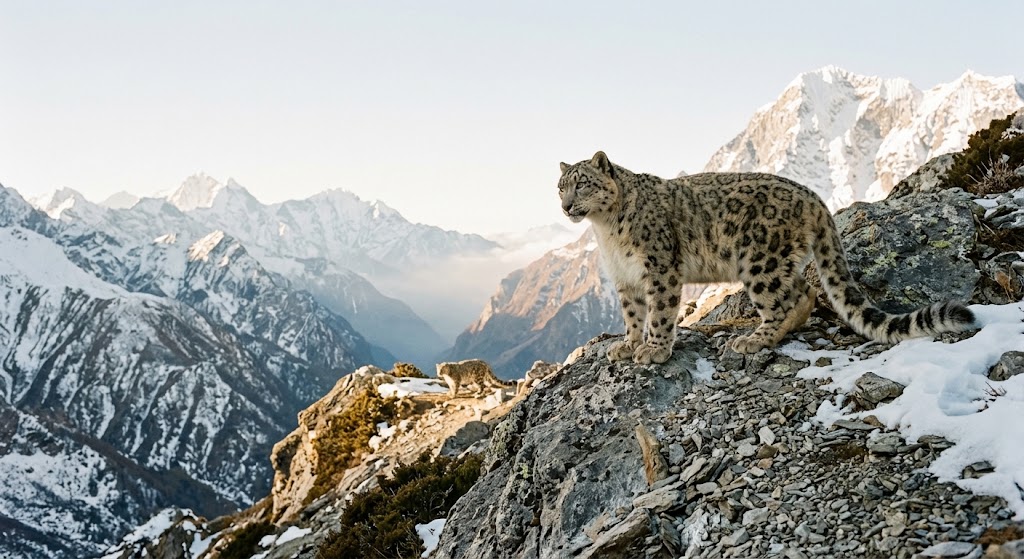
Snow leopards represent one of the most magnificent and least understood large predators on earth, inhabiting the remote high-altitude zones of the Himalayas where extreme cold, thin air, and rugged terrain create conditions that few animals and almost no humans ever experience directly. Nepal provides some of the most important snow leopard habitat remaining anywhere in the world, with the Upper Mustang, Dolpo, Humla, and Kangchenjunga conservation areas all supporting populations of these elusive cats that researchers are only beginning to understand through modern camera trap technology and GPS collar studies. The snow leopard’s ghost-like reputation comes from its extraordinary ability to move through rocky mountain terrain without detection, leaving only pawprints and prey remains as evidence of a predator that most wildlife professionals spend entire careers in Nepal without ever seeing in the wild.
Where Snow Leopards Live in Nepal and How They Survive the Himalayan Extreme
Snow leopards occupy a specific ecological niche within Nepal’s mountain landscape that their extraordinary physical adaptations allow them to exploit more effectively than any competing predator attempting to survive in equivalent conditions.
The Altitude Range and Geographic Distribution
Snow leopards inhabit elevations between 3,000 and 5,400 meters above sea level across Nepal’s northern regions where high Himalayan terrain meets the Tibetan Plateau. Nepal’s snow leopard population occupies approximately 25,000 square kilometers of suitable high-altitude habitat spread across the Annapurna Conservation Area, Kangchenjunga Conservation Area, Shey Phoksundo National Park in Dolpo, Manaslu Conservation Area, and the Api Nampa Conservation Area in far western Nepal.
Individual snow leopards maintain enormous home ranges that reflect the sparse prey distribution at high altitude. Males occupy territories averaging 200 to 400 square kilometers, while females maintain smaller ranges of 50 to 100 square kilometers that overlap with male territories without triggering the territorial conflict that many big cat species engage in when ranges overlap. This overlapping territory system allows snow leopards to utilize the available prey resources across vast mountain landscapes without constant competition that would be energetically unsustainable in a habitat where energy resources are already scarce.
Nepal’s Department of National Parks and Wildlife Conservation estimated the national snow leopard population at between 300 and 500 individuals based on camera trap surveys and population modeling that established baseline numbers for conservation planning. More recent surveys using improved camera trap networks suggest the population may exceed 500 individuals in years with favorable prey conditions, though population fluctuations track prey availability closely and vary significantly between drought and normal precipitation years.
The Physical Adaptations That Define the Species
Snow leopards evolved specific physical characteristics that enable survival in conditions that would kill most large carnivores within hours of exposure. Their thick fur contains longer outer guard hairs and dense woolly underfur that together create insulation performance comparable to the most advanced synthetic cold-weather materials human engineers have developed for extreme alpine environments.
The snow leopard’s exceptionally long, thick tail, sometimes reaching 90 centimeters in length, serves multiple functions simultaneously. The tail wraps around the face during rest to protect vulnerable nose and mouth tissue from freezing temperatures. It provides balance counterweight during high-speed pursuits across rocky terrain where each leap and landing demands precise weight distribution adjustments. Snow leopards also use their tails for communication, wrapping them around their bodies in various positions that other snow leopards read as social signals during the brief mating encounters that bring these solitary animals together each winter.
Enlarged nasal cavities warm and humidify the thin, dry air at high altitude before it reaches sensitive lung tissue, reducing the respiratory stress that altitude-naive animals experience severely when ascending rapidly into the snow leopard’s preferred elevation zone. Large, padded feet distribute body weight across snow surfaces that would swallow narrower-footed predators and provide the grip on rocky surfaces that high-speed prey pursuit demands across terrain that would challenge a trained human mountaineer moving slowly with full equipment.
Prey Species and Hunting Strategy
Snow leopards prey primarily on blue sheep, known locally as bharal, and Himalayan tahr across Nepal’s high-altitude zones. A single adult snow leopard requires approximately 20 to 30 large prey animals annually to meet its energy requirements, with successful hunts occurring every ten to fifteen days when prey is abundant and less frequently when prey populations thin due to harsh winters or disease.
Snow leopards hunt through patient stalking that exploits the rocky terrain and vegetation cover at high altitude. They approach prey from above, using cliff edges, boulder fields, and terrain folds to conceal their approach until they reach striking distance, then launch explosive charges that cover six to nine meters in a single leap from concealed positions that prey animals rarely detect before the attack begins.
Conservation Challenges and the Future of Nepal’s Snow Leopard Population
Nepal’s snow leopards face threats that research programs, conservation organizations, and government agencies work collaboratively to address through approaches that balance wildlife protection with the legitimate economic needs of mountain communities who share snow leopard habitat.
Human-Wildlife Conflict: The Primary Conservation Challenge
Livestock predation creates the most direct and emotionally charged conflict between snow leopards and the mountain communities whose herds share grazing territory with these predators. Mountain herders lose sheep, goats, horses, and yaks to snow leopard predation at rates that represent significant economic losses for households whose entire livelihood depends on livestock wealth that they invest years of effort accumulating.
Retaliatory killing of snow leopards following livestock losses represents a historically significant mortality source that conservation organizations in Nepal work to reduce through predator-proof corrals, livestock insurance programs, and community guardian networks that compensate herders for verified snow leopard kills on their animals. The Snow Leopard Trust and WWF Nepal both operate compensation programs in partnership with national park buffer zone communities that transform snow leopards from financial threats into wildlife assets whose presence generates compensation payments and tourism revenue.
The predator-proof corral program that provides reinforced overnight enclosures for livestock during the hours when snow leopards hunt most actively has reduced livestock losses by 80 to 90% in villages where corral adoption reached high levels. Snow leopards cannot break through properly constructed corral designs, redirecting their hunting attention toward wild prey and reducing the retaliatory killings that historically caused significant snow leopard mortality in Nepal’s buffer zone communities.
Camera Trap Research and Population Monitoring
Modern camera trap networks placed throughout Nepal’s snow leopard habitat have revolutionized researchers’ ability to monitor populations, identify individual animals through unique spot patterns, and track survival and reproduction rates that allow population trend assessments.
Nepal’s Department of National Parks and Wildlife Conservation coordinates camera trap surveys across multiple conservation areas that generate photographic databases of identified individual snow leopards. Each snow leopard carries a unique rosette and spot pattern across its coat that researchers use for individual identification in the same way scientists identify other spotted felids like leopards and cheetahs, allowing researchers to track individual animals across multiple survey years without the stress of capture and handling that GPS collar studies require.
Camera trap data revealed behaviors that field observation alone could never document, including detailed information about movement patterns, territorial boundary marking, prey selection, and social interaction during breeding season that expands understanding of snow leopard ecology necessary for effective conservation planning.
Climate Change and Habitat Transformation
Climate change threatens snow leopard habitat in Nepal through mechanisms that operate more powerfully at high altitude than at most other global ecosystems experiencing warming. The Himalayas are warming approximately three times faster than the global average, which shifts vegetation zones upward and reduces the alpine and subalpine habitat area that snow leopards occupy within their preferred elevation range.
As temperatures rise, tree lines advance to higher elevations, converting open rocky terrain and alpine meadows that snow leopards hunt effectively into forest habitat where these cats cannot pursue prey as successfully. The total snow leopard habitat area in Nepal could contract by 20 to 30% by 2100 under moderate warming scenarios, with the most dramatic losses occurring in the lower portions of current snow leopard range where warming effects manifest most rapidly.
Prey species including blue sheep and Himalayan tahr also face habitat changes that affect the population densities that support snow leopard reproduction and survival at current levels. Reduced prey density drives snow leopards into lower elevations where livestock vulnerability increases, intensifying the human-wildlife conflict that conservation programs invest significant resources to reduce.
Tourism as a Conservation Tool
Snow leopard tourism represents a growing economic incentive for conservation that mountain communities increasingly recognize as a viable alternative to livestock-centric livelihoods that generate conflict with the predators they share their landscape with. Dedicated snow leopard tracking expeditions in Upper Mustang, Dolpo, and the Manaslu region bring international wildlife tourists who pay premium prices for guided searches in prime snow leopard territory.
Local guides, camp staff, porters, and lodge owners all benefit economically from snow leopard tourism that creates community financial stakes in snow leopard survival that no conservation messaging campaign matches in motivational effectiveness. Communities that earn income through snow leopard tourism actively protect their local populations from poaching, report sightings to researchers, and reduce livestock grazing pressure on critical snow leopard habitat voluntarily because the economic calculation now favors wildlife coexistence over exploitation.
Conclusion:
Snow leopards in Nepal represent one of conservation science’s greatest successes and most demanding ongoing challenges simultaneously. Camera trap research, community-based conservation programs, predator-proof corrals, and snow leopard tourism together create conditions where Nepal’s population shows stability and in some areas genuine recovery from historical lows. Climate change introduces a long-term threat that no local conservation program can address independently without global emissions reduction commitments that international climate agreements must deliver. Every person who learns about snow leopards, supports conservation organizations working in Nepal, or chooses responsible wildlife tourism helps sustain the resources that protect these extraordinary cats and the wild Himalayan landscapes they need to survive. For more captivating wildlife content, conservation stories, natural history, and the environmental news that matters most to our planet’s future, visit DailyInfoRoom where curiosity about the natural world finds the knowledge and inspiration it deserves every single day.