

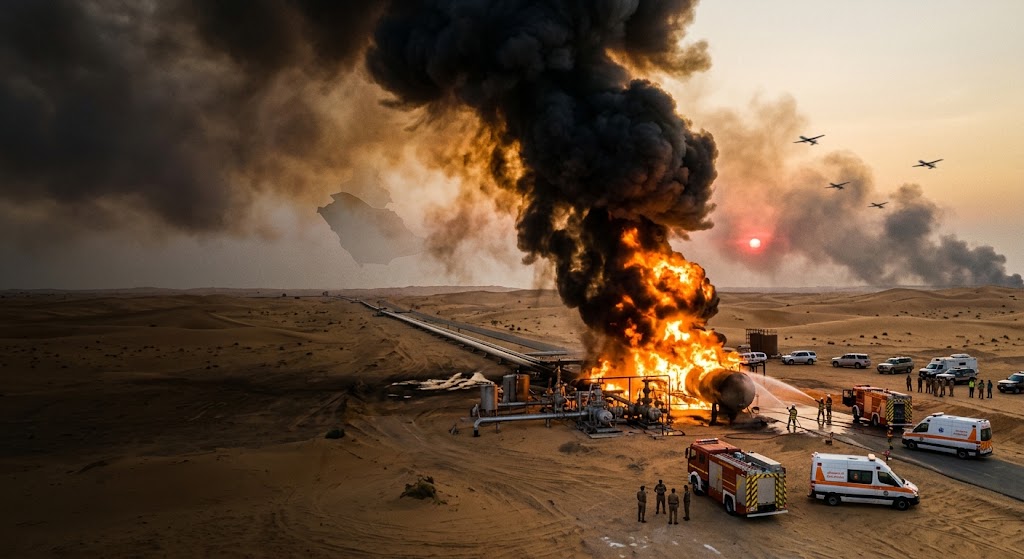
Iraq Drones targeted Saudi Arabia’s critical East-West Crude Oil Pipeline on September 10, 2026, in one of the most consequential energy infrastructure attacks of the 2026 Iran war. Saudi Arabia’s Ministry of Foreign Affairs confirmed that the pipeline was targeted in the Riyadh and Medina areas by several drones originating from Iraq, resulting in injuries and material damage. Saudi Arabia shut down the pipeline as a precautionary measure following the attack, temporarily removing its main alternative route for exporting crude oil while the Strait of Hormuz remained effectively closed by Iran. The timing and targeting of this attack carry strategic consequences that extend far beyond Saudi Arabia’s borders into global energy markets, regional security calculations, and the broader trajectory of a war that continues expanding its geographic scope and economic impact.
What Happened When Iraq Drones Struck the East-West Pipeline
On September 10 to 11, 2026, a series of drone strikes launched from Iraqi territory hit Saudi Arabia’s East-West Crude Oil Pipeline amid the wider 2026 Iran war. The attack struck one of the most strategically critical pieces of energy infrastructure in the entire Middle East at a moment when its importance to global oil supply had never been greater.
The Attack’s Scope and Physical Damage
Drones targeted the pipeline in the Riyadh and Medina regions on the morning of September 10, 2026, causing fires and damage to pump stations and injuring several people, the Saudi government said.
Two US officials told CNN that pump stations located next to the pipeline had been struck, and satellite imagery from the Copernicus Sentinel-3 satellite showed a black smoke plume over the pipeline route between Medina and Mahd Al-Dhahab, with NASA’s FIRMS system also detecting clustered thermal anomalies in the area.
Satellite images appear to show extensive fire damage at a pumping station near Al Mesba’ah, Saudi Arabia, on September 11, 2026. The visual evidence of major fires burning along the pipeline route confirmed what satellite thermal detection had already indicated about the scale of damage the Iraq Drones attack inflicted on multiple pump stations across a broad geographic area.
The Pipeline’s Critical Strategic Importance
The Iraq Drones attack struck at precisely the moment when the East-West pipeline had become Saudi Arabia’s most essential energy lifeline. With Iran effectively shuttering the Strait of Hormuz amid the ongoing war between the United States and Iran, Saudi Arabia had rerouted about 5 million barrels of oil per day that would otherwise have moved through the Gulf, sending it instead via the 1,200 kilometer East-West pipeline to the Red Sea port of Yanbu.
Saudi Aramco CEO Amin H. Nasser had said the previous month that the pipeline had played a bigger role in mitigating the oil supply disruption caused by the Iran war than the release of emergency crude reserves. Attacking this pipeline at this specific moment in the conflict therefore represented a calculated strategic choice to eliminate Saudi Arabia’s primary oil export bypass route simultaneously with Iran’s blockade of the Strait of Hormuz.
The pipeline, which carries about 4 to 5 percent of the global oil supply and allows Saudi Arabia to bypass the Strait of Hormuz, was shut down as a precaution following the attack, removing an enormous daily oil volume from global markets at a moment when energy security concerns already pushed oil prices above critical thresholds.
Iraq’s Response and the Drone Launch Platform
The Iraqi government acknowledged that the attack was launched from its territory and announced that it had dismissed the commander of Maysan province in the south of the country as a consequence.
Iraqi authorities said their security forces have located and seized a drone-launching platform allegedly used in an attack that struck Saudi Arabia’s East-West oil pipeline. This rapid operational response from Baghdad demonstrated the political urgency that Iraq’s government attached to demonstrating accountability for the Iraq Drones attack launched from its soil against a neighboring Arab nation’s critical infrastructure.
Lieutenant General Saad Maan, head of Iraq’s Security Media Cell, said that an intelligence and security task force had tracked down and seized the launch equipment. He also said that forensic and technical experts were continuing work to identify those behind the attack and that Iraq’s commander-in-chief had approved an Iranian request to join the investigation and review its findings.
The Wider Consequences and Regional Implications of the Iraq Drones Pipeline Attack
The Iraq Drones strike on the East-West pipeline does not exist in isolation. It forms part of a coordinated escalation pattern across the 2026 Iran war that simultaneously targeted multiple Saudi and regional security interests within a narrow timeframe.
The Houthi Dimension: A Two-Front Energy Crisis
Saudi Arabia said Friday it shut down a major pipeline a day after it was attacked by drones, and Yemen’s Iranian-backed Houthi rebels captured a strategic island at the southern entrance to the Red Sea, two officials said, opening a new front in the Iran war.
The Houthis made their biggest territorial gains in years along the Bab el-Mandeb Strait, one of the world’s key shipping lanes. The simultaneous Iraq Drones pipeline attack and Houthi capture of Bab el-Mandeb strategic positions created a two-front energy crisis for Saudi Arabia that no single defensive response could address comprehensively.
Political analyst Salim Zakhour told Al Jazeera that these developments are extremely complex for Saudi Arabia, pointing to the Houthis’ advance towards Bab al-Mandeb alongside the East-West oil pipeline strike, leaving Riyadh in a major defensive position, requiring real, practical steps to deter these attempts.
Saudi Arabia’s Measured Non-Retaliation Response
Saudi Arabia expressed its strongest condemnation but said it would not retaliate for now, following a request from Baghdad. This decision to withhold immediate military retaliation reflects Saudi Arabia’s reading of the current diplomatic environment where active negotiations involving Iran, the United States, and Gulf states create political incentives for restraint that direct military response would undermine.
The government in Riyadh said it intended not to react at this stage and to support the efforts of the Iraqi government to prevent attacks launched from its territory. Choosing diplomatic containment over military retaliation after the Iraq Drones attack demonstrates that Saudi Arabia prioritizes the negotiated resolution pathway that the broader 2026 Iran war diplomatic efforts pursue.
The Gulf Cooperation Council’s Collective Condemnation
The Gulf Cooperation Council, which brings together six countries in the region, issued a statement expressing concern and describing the incident as a dangerous escalation and an unacceptable threat to the security of the Kingdom of Saudi Arabia. The GCC’s collective condemnation signals that all six Gulf member states view the Iraq Drones pipeline attack as an attack on regional security architecture that threatens every Gulf state’s energy export infrastructure, not just Saudi Arabia’s facilities specifically.
Global Oil Market Impact
Saudi authorities confirmed that drone attacks launched from Iraq led to the temporary closure of a crucial oil export route used to bypass the lockdown of the Strait of Hormuz, as regional tensions and Red Sea threats pushed oil prices above $100.
The Iraq Drones attack on the East-West pipeline removes the bypass route that the international energy market had relied on to partially compensate for the Strait of Hormuz blockade. With both the Strait of Hormuz closed by Iran and the East-West pipeline shut following the Iraq Drones attack, the volume of Saudi oil reaching global markets dropped dramatically, amplifying the supply shock that global energy markets already absorbed from months of Iran war disruption.
Iran-Linked Militia Responsibility
Iran-allied militia groups in Iraq have used drones in the past to attack Saudi Arabia, according to Behnam Ben Taleblu, Iran program senior director at the Foundation for Defense of Democracies, and may have done so again amid a broader Iranian strategy to use its proxies to push Arab nations to reject American forces in the region.
No group claimed responsibility for the Iraq Drones attack publicly, but the pattern of previous Iranian proxy operations through Iraqi militia networks, the strategic timing alongside Houthi gains in Bab el-Mandeb, and the target selection targeting Saudi Arabia’s primary Hormuz bypass route all point toward a coordinated Iranian proxy strategy rather than independent militant action.
Conclusion:
The Iraq Drones attack on Saudi Arabia’s East-West pipeline on September 10, 2026, represents one of the most strategically significant energy infrastructure strikes of the 2026 Iran war, eliminating Saudi Arabia’s primary oil export bypass route at the precise moment when the Strait of Hormuz blockade made it most essential to global oil supply stability. Saudi Arabia’s measured non-retaliation response, Iraq’s rapid accountability measures, and the GCC’s collective condemnation together reflect the diplomatic complexity of a conflict where escalation carries consequences that every party in the region recognizes as extending far beyond any single military exchange. The attack’s global energy market impact will shape diplomatic pressure on all parties for weeks ahead. For comprehensive, real-time coverage of the Iran war, Middle East energy security, global oil markets, and geopolitical developments that shape the world economy, visit DailyInfoRoom where serious global journalism meets the readers who demand clear and reliable reporting on the events that matter most.