


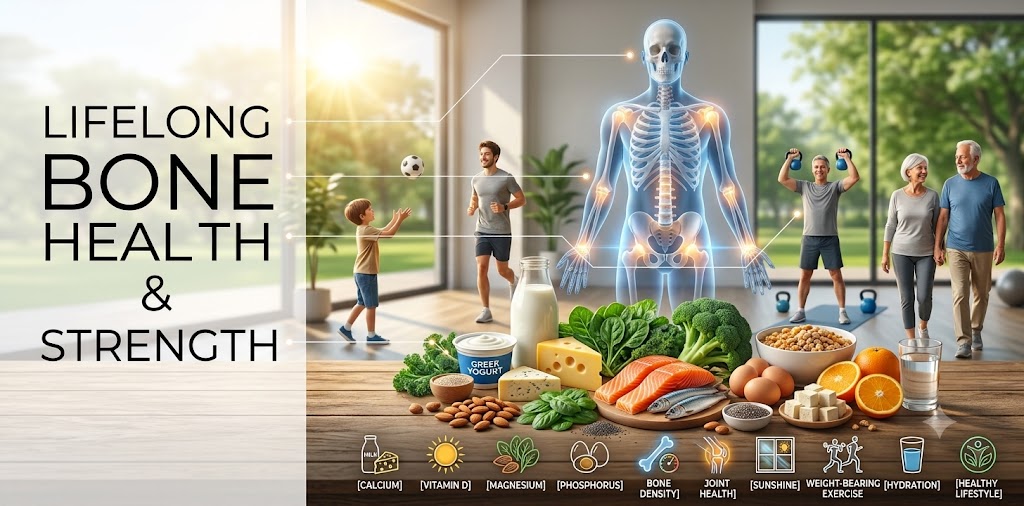
Bone Health determines the quality of your physical life more profoundly than most people recognize until a fracture, diagnosis, or mobility limitation forces the conversation. Your skeleton does far more than provide structural support. Bones store minerals, produce blood cells, regulate calcium levels in the bloodstream, and protect vital organs from impact and injury. Most people reach peak bone density around age 30 and begin losing bone mass gradually after that point. The choices made before, during, and after that peak determine whether bones remain strong and fracture-resistant through decades of active life or become progressively fragile and vulnerable. Building Bone Health requires understanding what drives bone strength at every life stage and acting on that knowledge consistently.
The Foundations of Strong Bone Health That Science Consistently Supports
Bone Health depends on a combination of nutritional, hormonal, and mechanical factors that work together to build and maintain bone density across your entire lifetime. Understanding each factor gives you the clearest possible roadmap for protecting your skeleton at any age.
Calcium Remains the Non-Negotiable Building Block
Calcium forms the primary mineral component of bone tissue, comprising approximately 70% of bone’s dry weight in the form of hydroxyapatite crystals that give bone its hardness and compressive strength. Adequate calcium intake throughout every life stage represents the most fundamental Bone Health practice any person can adopt.
Adults between 19 and 50 years old need 1,000 milligrams of calcium daily. Women over 50 and men over 70 need 1,200 milligrams daily to compensate for the increased calcium loss that hormonal changes and aging drive. Dairy products deliver the most bioavailable dietary calcium, with one cup of milk providing approximately 300 milligrams. Fortified plant milks, canned salmon with bones, sardines, firm tofu, kale, and bok choy all deliver meaningful calcium contributions for people who avoid or limit dairy.
Food sources always outperform supplements for Bone Health support because whole foods deliver calcium alongside the cofactors that optimize its absorption and utilization. Supplement use makes sense when diet genuinely cannot meet requirements, but calcium supplements taken without vitamin D and magnesium deliver significantly reduced Bone Health benefits compared to food-based calcium intake.
Vitamin D Unlocks Calcium Absorption
Vitamin D deficiency undermines Bone Health completely regardless of calcium intake because the intestinal absorption of dietary calcium depends entirely on adequate vitamin D levels. Without sufficient vitamin D, the body absorbs only 10 to 15% of dietary calcium. Adequate vitamin D raises that absorption rate to 30 to 40%, making vitamin D a Bone Health factor of equal importance to calcium itself.
Sunlight exposure triggers vitamin D synthesis in skin tissue, with 15 to 30 minutes of midday sun exposure on arms and legs providing adequate production for most light-skinned adults in sunny climates. People with darker skin tones, those living at higher latitudes, elderly individuals whose skin synthesis efficiency declines with age, and anyone who spends most time indoors need supplemental vitamin D to maintain the blood levels that Bone Health requires.
The National Institutes of Health recommends 600 IU of vitamin D daily for adults under 70 and 800 IU for adults over 70, though many Bone Health specialists argue that optimal blood levels require higher supplemental doses for deficient individuals, with specific dosing guided by blood test results rather than general population recommendations.
Magnesium and Vitamin K2 Complete the Bone Health Equation
Magnesium activates vitamin D, regulates calcium transport across cell membranes, and directly contributes to the crystalline structure of bone tissue. Approximately 60% of the body’s total magnesium stores sit within bone, making it a structural component as well as a metabolic cofactor for Bone Health processes. Nuts, seeds, leafy green vegetables, legumes, and whole grains all deliver meaningful magnesium quantities that support bone mineral density maintenance.
Vitamin K2 directs calcium toward bone tissue and away from arterial walls where calcium deposits contribute to cardiovascular disease. This directional role makes vitamin K2 an underappreciated but genuinely important Bone Health nutrient that calcium and vitamin D supplementation strategies frequently overlook. Fermented foods including natto, aged cheeses, and certain yogurt cultures deliver dietary vitamin K2, with natto providing the highest concentrations available from any food source.
Protein Supports Bone Matrix Structure
Collagen forms the organic matrix of bone upon which mineral crystals deposit to create the composite structure that gives bone both hardness and flexibility. Adequate dietary protein provides the amino acid building blocks that collagen synthesis requires, making protein intake a Bone Health factor that receives less attention than calcium despite its equal structural importance.
Research consistently confirms that higher protein intake associates with greater bone density and lower fracture risk in adults across age groups when calcium intake meets recommendations simultaneously. Concerns that protein intake increases calcium excretion and thereby harms Bone Health have not been substantiated in long-term population studies where total dietary quality and calcium adequacy are properly controlled.
Lifestyle Practices That Build and Protect Bone Health Across Every Decade of Life
Nutrition builds the biological raw materials for strong bones. Lifestyle practices determine whether those materials get assembled into dense, fracture-resistant bone tissue or lost faster than the body replaces them.
Weight-Bearing Exercise Sends the Strongest Bone-Building Signal
Physical forces applied to bone through weight-bearing exercise trigger bone-forming cells called osteoblasts to deposit new bone tissue in response to the mechanical stress. This adaptive response makes exercise the most powerful lifestyle tool for building Bone Health during growth years and maintaining it throughout adulthood.
Walking, running, hiking, dancing, tennis, basketball, and strength training all qualify as weight-bearing activities that stimulate bone formation. Swimming and cycling, despite their excellent cardiovascular benefits, provide minimal Bone Health stimulus because water buoyancy and cycling mechanics eliminate the ground reaction forces that trigger osteoblast activity.
Resistance training delivers Bone Health benefits through muscle contraction forces applied to bone attachment points in addition to gravitational loading. Research from multiple randomized controlled trials confirms that progressive resistance training two to three times weekly increases bone density at the spine and hip, the sites most vulnerable to osteoporotic fracture, in postmenopausal women who represent the highest-risk population for bone loss.
Smoking Destroys Bone Health Systematically
Smoking damages Bone Health through multiple simultaneous mechanisms that accumulate into significantly elevated fracture risk over years of tobacco use. Nicotine directly inhibits osteoblast activity, reducing the rate of new bone formation. Smoking reduces intestinal calcium absorption, lowers estrogen levels in women and testosterone levels in men, impairs blood supply to bone tissue, and increases the activity of osteoclasts, the cells responsible for bone breakdown.
Research consistently shows that smokers carry 25 to 50% higher hip fracture risk than non-smokers after controlling for other risk factors. The good news is that quitting smoking allows partial Bone Health recovery over time, with former smokers showing gradual improvement in bone density measurements after cessation, making smoking cessation one of the highest-impact Bone Health interventions available.
Alcohol Consumption Weakens Bone Systematically
Heavy alcohol consumption disrupts Bone Health through mechanisms that include reduced osteoblast activity, impaired calcium absorption, hormonal disruption, and increased fall risk from balance and coordination impairment. Research defines heavy drinking as more than two drinks daily for men and more than one drink daily for women in the context of Bone Health risk assessment.
Moderate alcohol consumption shows less clear negative effects on bone density in research literature, but the fall risk that any alcohol consumption creates represents an independent Bone Health hazard separate from the direct metabolic effects on bone tissue. Falls cause approximately 95% of hip fractures, making fall prevention a central component of Bone Health protection strategy at every age.
Bone Density Testing Provides Essential Baseline Information
DXA scanning measures bone mineral density and generates T-scores that compare an individual’s bone density to the average peak bone density of a healthy young adult population. Women over 65 and men over 70 warrant routine DXA screening. Younger adults with significant risk factors including family history of osteoporosis, long-term corticosteroid use, early menopause, or multiple fractures from minor trauma benefit from earlier Bone Health screening.
Knowing your bone density baseline enables informed decisions about treatment urgency, lifestyle modification priorities, and medication options for those with osteoporosis or significant osteopenia. Many people discover significant bone loss only after a fracture occurs, making proactive screening a genuine Bone Health investment rather than an unnecessary medical expense.
Sleep Quality Affects Bone Metabolism
Research published in the Journal of Bone and Mineral Research confirmed that short sleep duration associates with lower bone density measurements in multiple anatomical sites. Bone remodeling, the continuous process where osteoclasts break down old bone and osteoblasts deposit new bone, follows a circadian rhythm that peaks during sleep hours. Disrupted sleep interrupts this remodeling cycle and creates an imbalance that favors bone loss over bone formation over time.
Seven to nine hours of quality sleep nightly supports the Bone Health remodeling cycle that maintains bone density independent of nutritional and exercise inputs. Treating sleep disorders including sleep apnea, which research specifically links to reduced bone density, protects Bone Health through mechanisms that daytime behaviors alone cannot compensate for adequately.
Conclusion:
Bone Health requires consistent attention across every decade of life rather than a single intervention at the moment problems appear. Calcium and vitamin D provide the nutritional foundation. Weight-bearing exercise sends the mechanical signals that stimulate bone formation. Avoiding smoking and heavy alcohol removes the most destructive lifestyle factors undermining your skeletal integrity. Quality sleep supports the remodeling cycle that maintains bone density nightly. Regular density testing reveals your current status and guides your response. Every habit that supports Bone Health today reduces fracture risk and protects physical independence for the decades ahead. Start building those habits now regardless of your current age. For more essential health guides, nutrition strategies, and evidence-based wellness content that protects your long-term wellbeing, visit DailyInfoRoom where the knowledge your body needs finds the readers committed to using it.












