


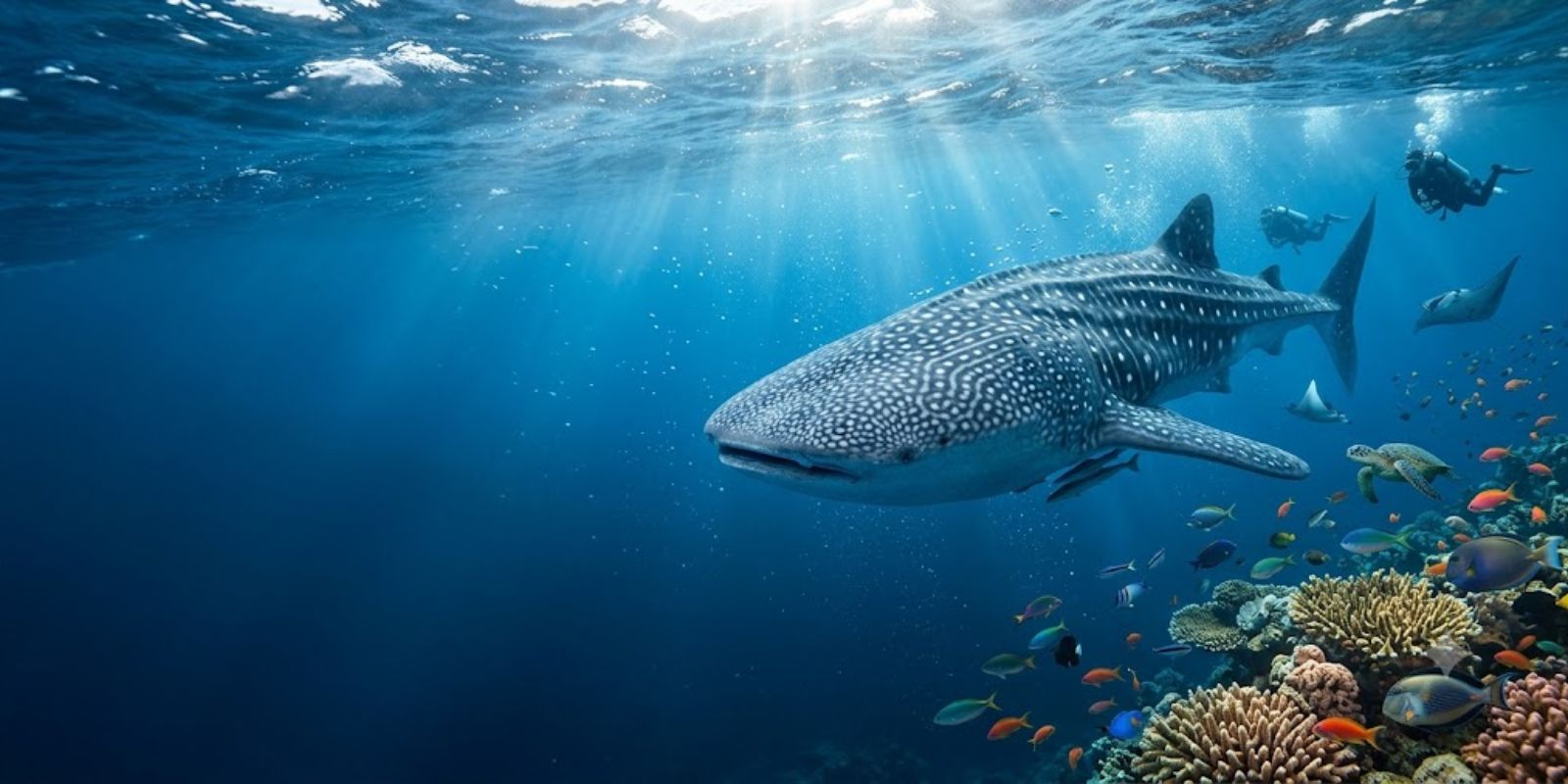
Meet the ocean’s biggest fish the whale shark and you will instantly understand why marine biologists dedicate entire careers to studying this magnificent creature. Reaching lengths of up to 18 meters and weighing as much as 20 metric tons, the whale shark dwarfs every other fish on the planet. Despite its enormous size, this gentle giant poses zero threat to humans. It cruises through warm tropical waters with calm, unhurried grace, filtering massive volumes of seawater for tiny plankton and fish eggs. The whale shark is a living contradiction the largest fish alive, yet one of the most peaceful predators in the ocean. Its story deserves to be told.
Meet the Ocean’s Biggest Fish Size, Biology, and Behavior That Defy Imagination
When you meet the ocean’s biggest fish in person, the scale of the encounter is something no photograph fully prepares you for. Whale sharks are not just large — they represent a category of size that exists almost nowhere else in the animal kingdom outside of the great whales themselves.
Record-Breaking Size and Weight
The average adult whale shark measures between 9 and 12 meters in length. The largest confirmed specimen on record stretched over 18 meters longer than a school bus. Scientists estimate that the largest individuals weigh upward of 20 metric tons. Their mouths alone span approximately 1.5 meters wide, wide enough to swallow a small person whole though they never would, because whale sharks eat almost exclusively microscopic organisms.
Despite belonging to the shark family, whale sharks share far more behavioral similarities with gentle ocean giants like manta rays and baleen whales than with predatory sharks like great whites or tiger sharks.
A Filter Feeder Unlike Any Other
The whale shark feeds by swimming slowly through the water with its enormous mouth open wide, filtering out plankton, fish eggs, krill, small squid, and tiny fish from hundreds of thousands of liters of seawater every hour. This feeding strategy called filter feeding requires no chasing, no biting, and no aggression.Whale sharks rely on three distinct feeding mechanisms. Ram feeding involves swimming forward with an open mouth and letting water flow passively through. Active suction feeding pulls water in with muscular contractions. Stationary feeding positions the shark vertically in the water column and pumps water through its gill rakers. Each method suits different prey concentrations and environmental conditions.
Unique Spot Patterns A Natural Fingerprint
Every whale shark carries a unique pattern of white spots and stripes across its dark gray skin. No two individuals share the same pattern much like human fingerprints. Marine biologists exploit this characteristic to identify and track individual sharks over time using photo-identification databases.
The Wildbook for Whale Sharks platform uses an algorithm originally developed by NASA to map star patterns, repurposed to match whale shark spot configurations from photographs submitted by researchers and divers worldwide. This citizen science approach has built one of the largest wildlife identification databases in existence, helping scientists understand migration routes, growth rates, and population health when you meet the ocean’s biggest fish anywhere in the world.
Slow Growth and Extraordinary Longevity
Whale sharks grow slowly and live long lives. Scientists estimate their lifespan at somewhere between 70 and 150 years, though confirming exact ages in wild animals proves difficult. Growth rate studies suggest whale sharks take approximately 25 to 30 years to reach sexual maturity an exceptionally long developmental timeline that makes population recovery from decline extremely slow. A female whale shark carries eggs internally and gives birth to live pups. Researchers discovered a pregnant female in 1996 carrying 300 pups the largest litter ever recorded in any shark species. Despite this reproductive capacity, the slow road to maturity keeps population growth rates low.
Where to Find Them, Why They Matter, and What Threatens Their Survival
Meet the ocean’s biggest fish in the wild and you quickly realize that protecting whale sharks is not just about preserving one species it is about maintaining the health of entire marine ecosystems.
Where Whale Sharks Roam
Whale sharks inhabit tropical and warm temperate oceans worldwide, generally staying within waters between 30 degrees north and 35 degrees south latitude. They show strong preferences for areas with high plankton concentrations, which drive seasonal aggregations in predictable locations. Ningaloo Reef in Western Australia hosts one of the world’s most reliable and well-studied whale shark aggregations each year between March and July. The Yucatan Peninsula in Mexico, particularly near Holbox Island and Isla Mujeres, draws massive gatherings during summer months when tuna spawn attracts enormous numbers of whale sharks to feed on fish eggs. The Philippines, the Maldives, Mozambique, and the Seychelles all support significant whale shark populations and draw eco-tourism from across the globe.
Whale sharks follow food availability across vast ocean distances. Satellite tagging studies reveal that individual sharks travel thousands of kilometers between feeding grounds and deeper ocean habitats, crossing international boundaries and ocean basins with remarkable consistency year after year.
The Role Whale Sharks Play in Ocean Health
Meet the ocean’s biggest fish and you encounter an organism that scientists classify as a keystone indicator species — one whose presence signals a healthy, productive marine environment. Whale sharks congregate where plankton blooms and fish spawning events create rich feeding opportunities. Their presence confirms that the base of the marine food web remains robust and productive.
Whale shark feeding activity also contributes to nutrient cycling in the water column. Their movements redistribute organic material across ocean layers, influencing the productivity of the ecosystems they pass through. Removing apex and keystone species from any ecosystem triggers cascading effects that destabilize food webs in ways scientists continue to study and document.
Threats Pushing Whale Sharks Toward Extinction
The International Union for Conservation of Nature lists whale sharks as Endangered on its Red List. Their population has declined by more than 50% over the past 75 years — a trajectory that demands urgent attention from governments, conservation organizations, and the public.
Fishing poses the most direct threat. Hunters in several countries historically targeted whale sharks for their fins, meat, liver oil, and skin. Despite international trade protections under CITES and fishing bans in multiple nations, illegal hunting continues. Vessel strikes from large ships represent another serious mortality risk, particularly in busy shipping lanes that overlap with whale shark habitats. Plastic pollution, ocean warming, and the decline of plankton-rich upwelling zones all reduce food availability for whale sharks across their range. Climate change shifts the distribution and timing of the plankton blooms that whale sharks depend on, disrupting feeding aggregations that have followed predictable seasonal patterns for thousands of years.
Conservation Efforts Making a Difference
Research programs, marine protected areas, and eco-tourism initiatives have all contributed to growing awareness and protection of whale sharks globally. Swim-with-whale-shark tourism generates significant economic value for coastal communities in the Philippines, Australia, and Mexico creating powerful local incentives to protect the animals rather than hunt them. Satellite tagging programs continue to build detailed pictures of whale shark movement patterns, informing the placement of marine protected areas and shipping lane adjustments that reduce vessel strike risks. Scientists at research institutions across multiple continents collaborate on population assessments that guide international conservation policy. The effort to meet the ocean’s biggest fish with respect and protection rather than exploitation represents real progress but the work remains unfinished
Conclusion :
Meet the ocean’s biggest fish and you meet one of the most extraordinary animals on Earth. The whale shark combines record-breaking size with gentle behavior, ancient biology with cutting-edge conservation science, and global wandering with predictable seasonal patterns that researchers now understand better than ever before. Protecting this species means protecting the ocean ecosystems that sustain all marine life and ultimately, the health of the planet itself. Every photograph submitted to a citizen science database, every eco-tourism dollar spent responsibly, and every fishing ban enforced brings whale sharks closer to a secure future. For more fascinating wildlife stories, ocean science, and content that deepens your connection to the natural world, visit DailyInfoRoom where knowledge and curiosity meet every day.