


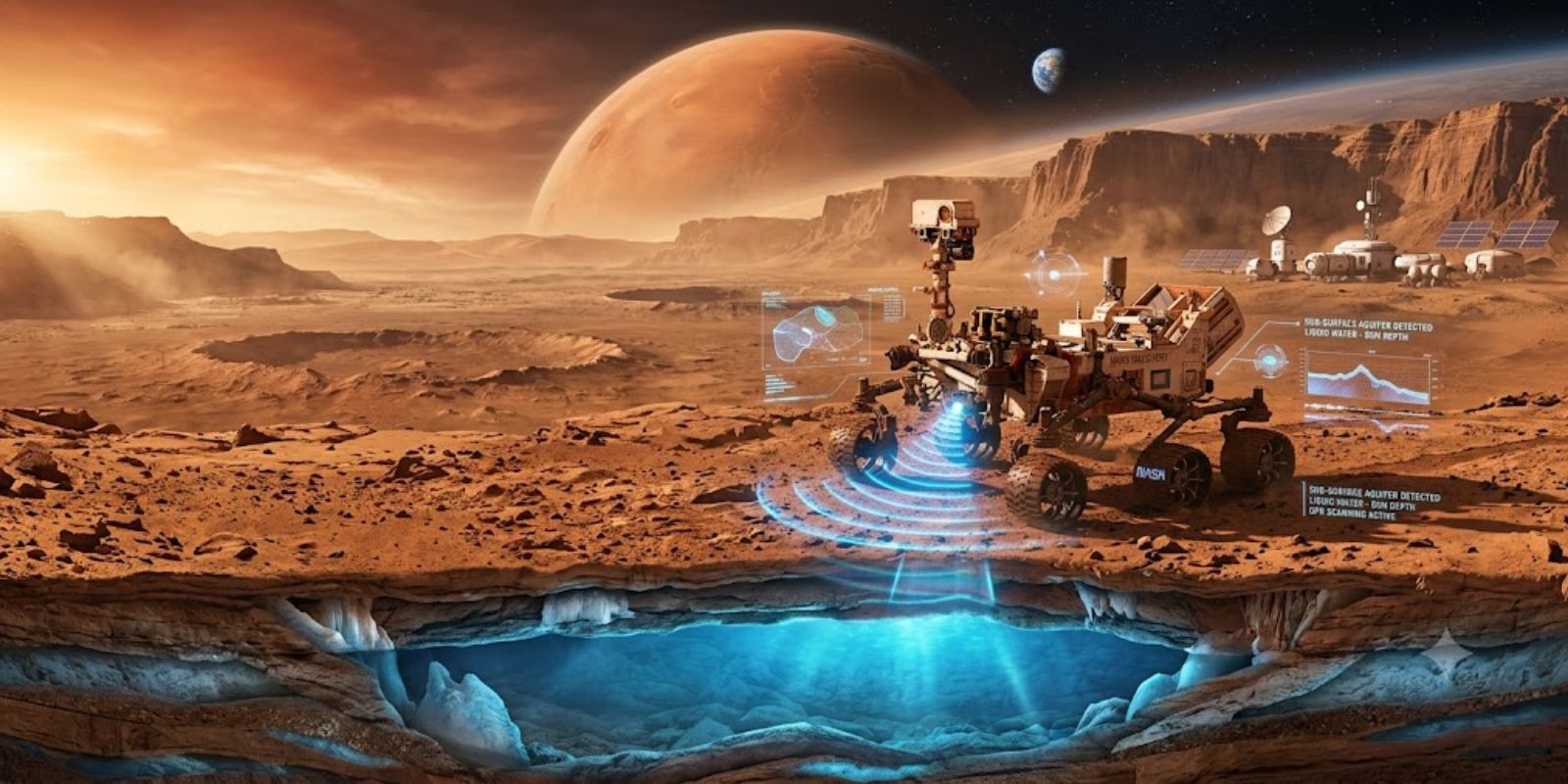
Mars hidden water has become one of the most exciting and hotly debated topics in modern planetary science. For decades, researchers assumed Mars was a dry, dead world a barren rock with nothing but dust storms and craters. New discoveries have shattered that assumption completely. Evidence now points to liquid water existing beneath the Martian surface, locked under layers of ice and rock in underground reservoirs. This changes everything we thought we knew about Mars. It raises serious questions about the possibility of microbial life, the viability of future human colonization, and the deeper story of how Mars evolved from a once-wet world into the frozen desert it appears to be today.
The Evidence What Scientists Have Found to Support Mars Hidden Water
The search for Mars hidden water has produced some of the most groundbreaking findings in space exploration history. Multiple missions, instruments, and research teams have contributed pieces to this growing puzzle.
Radar Signals Beneath the South Pole
In 2018, scientists using the MARSIS radar instrument aboard the European Space Agency’s Mars Express orbiter detected something extraordinary. A 20-kilometer-wide zone of high radar reflectivity sat approximately 1.5 kilometers beneath the south polar ice cap of Mars. The radar signal matched the pattern that liquid water produces when radar waves pass through it.
The research team, led by Roberto Orosei at the Italian National Institute of Astrophysics, published their findings in the journal Science. The conclusion pointed directly to a subglacial lake of liquid water sitting beneath a thick sheet of Martian ice — the first direct evidence of Mars hidden water in liquid form beneath the planet’s surface.
Multiple Subglacial Lakes Detected
A follow-up study published in 2020 expanded the picture significantly. Researchers analyzed additional MARSIS data and identified not one but three more bright radar reflections surrounding the original discovery zone. This suggested the presence of multiple interconnected subglacial lakes beneath the Martian south pole — a network of hidden water, not just an isolated pocket.
Scientists pointed out that similar subglacial lake systems exist on Earth beneath Antarctica and Greenland. Microbial life thrives in those environments despite the extreme cold and darkness. The parallel with Mars hidden water is scientifically significant and difficult to ignore.
Ancient Riverbeds and Dried Ocean Floors
Orbital imaging and surface exploration by NASA rovers have revealed dried riverbeds, ancient lake basins, and mineral deposits that only form in the presence of liquid water. The Curiosity rover discovered clay minerals and sulfate salts in Gale Crater direct chemical evidence that water once flowed and pooled there for extended periods.
The Perseverance rover, currently exploring Jezero Crater, operates in what scientists believe was once a river delta. Sedimentary rock layers in the crater tell a clear story of a past environment rich with flowing and standing water. Mars hidden water is not just a present-day mystery it is also a record written into the planet’s geology across billions of years.
Recurring Slope Lineae
Dark streaks observed on Martian slopes, known as Recurring Slope Lineae, generated enormous excitement among planetary scientists. These features appear seasonally on sun-facing slopes and fade during colder periods. Early interpretations suggested liquid briny water seeping to the surface and evaporating. Later research complicated that picture, with some scientists arguing the streaks result from dry granular flows. Mars hidden water research continues to debate the true nature of these features, keeping the scientific community actively engaged.
What Mars Hidden Water Means for Life, Exploration, and Humanity’s Future
Discovering water on Mars carries consequences that stretch far beyond scientific curiosity. It reshapes the entire framework of how humanity thinks about Mars as a destination and as a potential cradle for life.
The Possibility of Microbial Life
Liquid water is the single most essential ingredient for life as science understands it. Every known living organism on Earth requires water to survive and function at the cellular level. The discovery of Mars hidden water in subglacial lakes raises the genuine possibility that microbial organisms could exist or could have existed in those dark, cold, pressurized environments beneath the Martian surface.
Extremophile organisms on Earth survive in conditions that once seemed impossible for life. Bacteria thrive beneath Antarctic ice sheets in liquid water that reaches temperatures well below zero Celsius, kept liquid by the pressure above and the salt content within. Mars hidden water environments could mirror those conditions closely enough to support similar life forms.
No confirmed discovery of Martian life exists yet. The scientific community remains cautious and demands rigorous evidence before drawing definitive conclusions. The search for biosignatures chemical or structural markers of biological activity has become a primary mission objective for current and future Mars exploration programs.
Implications for Human Colonization
Water is not just a scientific curiosity for future Mars settlers — it is a survival resource. Human colonization of Mars requires water for drinking, agriculture, oxygen production, and rocket propellant manufacturing through a process called electrolysis, which splits water molecules into hydrogen and oxygen.
Mars hidden water changes the resource calculation for human missions dramatically. If accessible underground water exists in sufficient quantities, future colonists may not need to transport all their water from Earth or rely entirely on extracting water ice from polar caps. Underground water sources could become the foundation of a self-sustaining Mars colony.
Space agencies including NASA and ESA have identified water resource mapping as a critical priority for upcoming missions. Robotic drills, ground-penetrating radar systems, and seismic sensors all feature in plans for confirming and characterizing Mars hidden water deposits before humans arrive.
What Happened to Mars’s Ancient Water
Mars did not always look the way it does today. Approximately 3.5 to 4 billion years ago, Mars possessed a thicker atmosphere, warmer temperatures, and liquid water on its surface in abundance. River systems carved the valleys visible from orbit today. Oceans may have covered significant portions of the northern hemisphere.
Mars lost most of its magnetic field billions of years ago. Without that protective shield, solar wind stripped away the Martian atmosphere layer by layer over geological time. As the atmosphere thinned, temperatures dropped and surface water froze or evaporated into space. Mars hidden water the remnants of that once-abundant supply — migrated underground where pressure and salt content keep portions of it in liquid form despite the extreme cold above.
Understanding this planetary transformation helps scientists model climate change on a geological scale and provides sobering context for studying Earth’s own atmospheric dynamics and long-term habitability.
Upcoming Missions Targeting Mars Hidden Water
The scientific community has not stopped at detection. Several planned missions aim to investigate Mars hidden water directly. ESA’s ExoMars rover carries a drill designed to reach below the surface and analyze subsurface material for signs of biological or chemical activity. NASA continues developing advanced radar and geophysical instruments for future orbiters and landers.
Private space companies are also entering the picture. The ambition to reach Mars within this decade keeps pressure on space agencies to answer fundamental questions about subsurface water before crewed missions launch. Mars hidden water sits at the center of that research agenda.
Conclusion:
Mars hidden water represents one of the most profound scientific discoveries of the 21st century. It tells us that Mars is not the simple dead world early astronomers imagined. Liquid water persists beneath its frozen surface, holding secrets about planetary evolution, the potential for extraterrestrial life, and the resources future explorers will need to survive. Every radar scan, every rover sample, and every mission launched brings humanity closer to definitive answers. The story of Mars hidden water is still unfolding and its final chapter may redefine life’s place in the universe. For more compelling science stories, space exploration updates, and discoveries that expand your understanding of the cosmos, visit DailyInfoRoom your window to the knowledge that matters most.












